Governments move to wrap their arms around frontier AI — UN dialogue opens today in Geneva
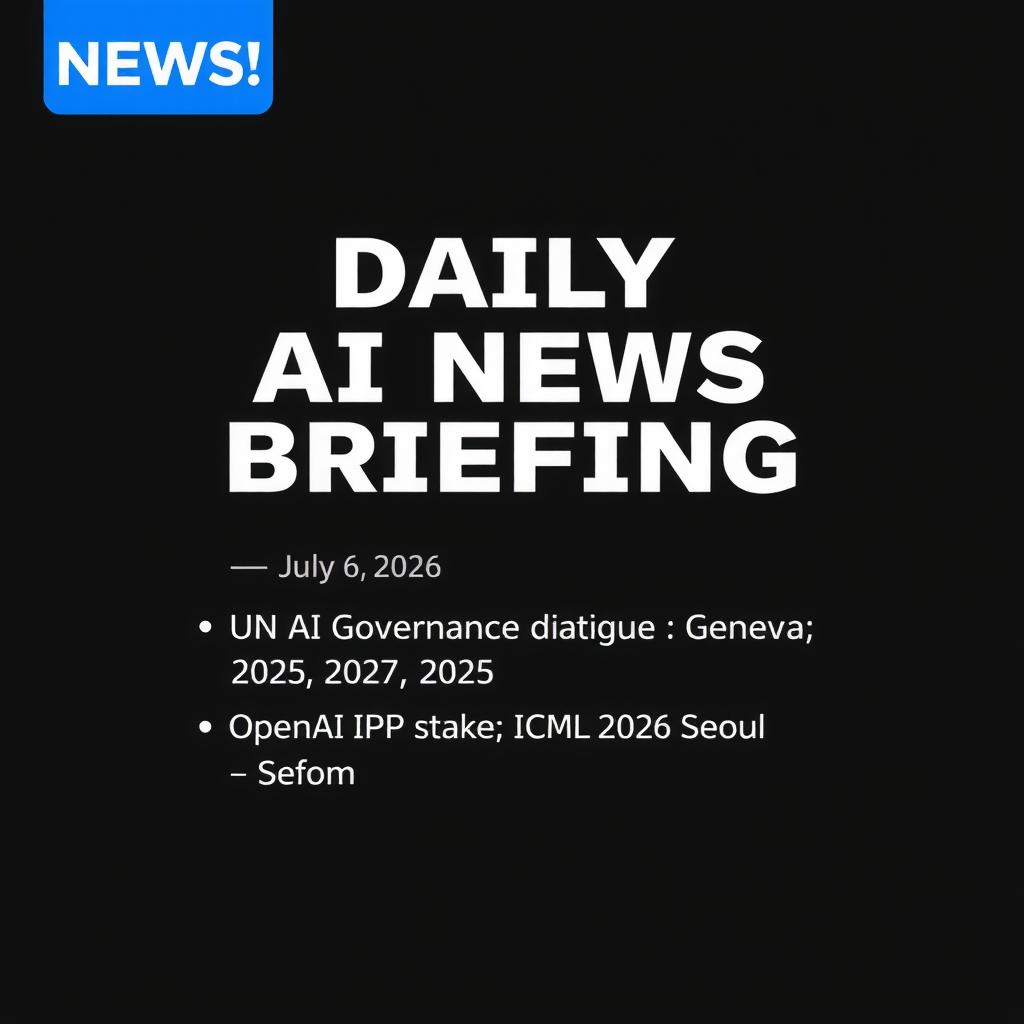
The first-ever UN Global Dialogue on AI Governance kicks off today in Geneva, bringing together nations to shape how AI is governed worldwide. Meanwhile, OpenAI has offered the U.S. government a 5% equity stake worth over $42 billion ahead of its IPO, the White House is finalizing voluntary model release standards, and ICML 2026 opens in Seoul with a record 23,918 submissions and agentic AI as the dominant theme.
Updates
The first session of the UN Global Dialogue on AI Governance opened today in Geneva, running July 6–7 alongside the WSIS+20 Forum and ITU's AI for Good summit. UNESCO is co-convening the event, which aims to establish shared principles for safe, inclusive AI development. The dialogue marks a turning point — moving from abstract policy debates to concrete international coordination on frontier AI risks, model transparency, and equitable access. Over 50 UN partner organizations are participating.
UNESCO coverage →OpenAI has proposed giving the U.S. government a 5% equity stake valued at approximately $42.6 billion, per the Financial Times. The proposal, confirmed by multiple outlets today, is part of OpenAI's larger push toward an IPO and comes as the company navigates increasing government scrutiny of frontier AI models. Sam Altman argued in a Forbes op-ed that a U.S. government stake would align national security interests with OpenAI's commercial trajectory — though critics warn it could create conflicts of interest in AI regulation.
Forbes → Reuters →Anthropic has overtaken OpenAI in annualized revenue, hitting a $30B+ run rate driven by enterprise adoption of Claude Code and Claude Sonnet 5. The milestone — confirmed by multiple financial outlets — marks a seismic shift in the AI industry landscape. Anthropic's leaner training costs and developer-focused strategy (particularly Claude Code's dominance in coding agent workflows) have catapulted it past its chief rival. The company also quietly launched Claude Science, an AI workbench for researchers bundling literature review, experiment analysis, and lab documentation tools into one interface.
Week in review → Claude Code review (8.2/10) →ICML 2026 opens today in Seoul with a record 23,918 paper submissions — double last year's total — and an unprecedented focus on agentic AI. At least 60 of 247 workshop proposals featured some variant of "agentic AI," with accepted events including "Agents in the Wild" and "Statistical Frameworks for Agentic Systems." The peer-review system is straining under the volume, with watermark-based LLM detection being tested to flag AI-generated submissions. The conference runs through July 11 at COEX Convention Center.
ICML 2026 → TechTimes →Microsoft launched Microsoft Frontier Company, a $2.5B subsidiary embedding 6,000 engineers and industry experts directly at customer sites to help select, integrate, and deploy AI tools. The new unit — announced July 2 but dominating analyst calls today — aims to turn AI spending into measurable returns. Fortune reports the move is Microsoft's answer to the "AI integration gap": companies buying AI tools but failing to see ROI because they lack the expertise to deploy them effectively.
Fortune → Microsoft Blog →The White House is finalizing a voluntary AI framework for frontier model releases, building on President Trump's June Executive Order on AI innovation and security. The framework — expected to be announced this week — would establish voluntary early-access protocols where frontier labs share models with government reviewers before public deployment. It's part of a broader push that includes the UN dialogue and the Partnership on AI's new global measurement initiatives announced earlier today.
AI&Sons analysis →Partnership on AI (PAI) announced two new global initiatives today to measure progress in responsible AI development. The tools aim to give governments, companies, and civil society standardized metrics for tracking AI safety, fairness, transparency, and accountability. The launch coincides with the UN Global Dialogue and signals a growing push for measurable, enforceable AI standards rather than high-level principles alone.
BusinessWire →KIDZ AI won the 2026 EdTechX Award for the Americas and unveiled KIDZBot, an AI-native robotics learning platform for K-12 education. The platform combines a physical robotics kit with an AI teaching assistant that adapts lessons to student skill levels. Commercial rollout is expected in Q3 2026. The news sent KIDZ AI (NASDAQ: KIDZ) to the top gainer list today.
Yahoo Finance →Grok 4.5 is now in private beta at SpaceX and Tesla, built on xAI's 1.5T-parameter V9 foundation model. Elon Musk confirmed the model was trained with supplemental coding data from Cursor, positioning it as a hybrid frontier model with both broad knowledge and specialized coding capability. Broader public availability is expected as early as this month, following xAI's new monthly release cadence.
AI Tools Recap →Tool spotlight
Claude Code
AI Coding Agent (CLI) — Premium, CLI, for developers. Despite the ongoing Alibaba backdoor controversy, Claude Code (9.0/10) remains the most capable coding agent on the market and is the primary driver of Anthropic's $30B+ revenue surge. Its tool-use architecture, deep repository understanding, and multi-file editing capabilities set the standard for AI-assisted software development. Score breakdown: Ease: 8, Features: 10, Performance: 10, Docs: 8, Support: 9.
Full review →Tip
With Anthropic's Claude Science now available as a free workbench for researchers (applications open through July 15), academic and industry researchers should apply early. The platform bundles literature review automation, experiment documentation, and AI-assisted analysis into one interface — potentially saving hours per day on research workflows. Apply at anthropic.com/news/claude-science-ai-workbench.
📖 Related Reads
- ToolBrain — tool reviews, LLM comparisons, and AI workflow guides
- NiteAgent — AI agent development, frameworks, and production patterns
- CodeIntel Log — code quality, debugging, and software engineering benchmarks
- Hermes Tutorials — Hermes Agent setup, configuration, and advanced workflows
Cross-links automatically generated from None.
Back to all posts