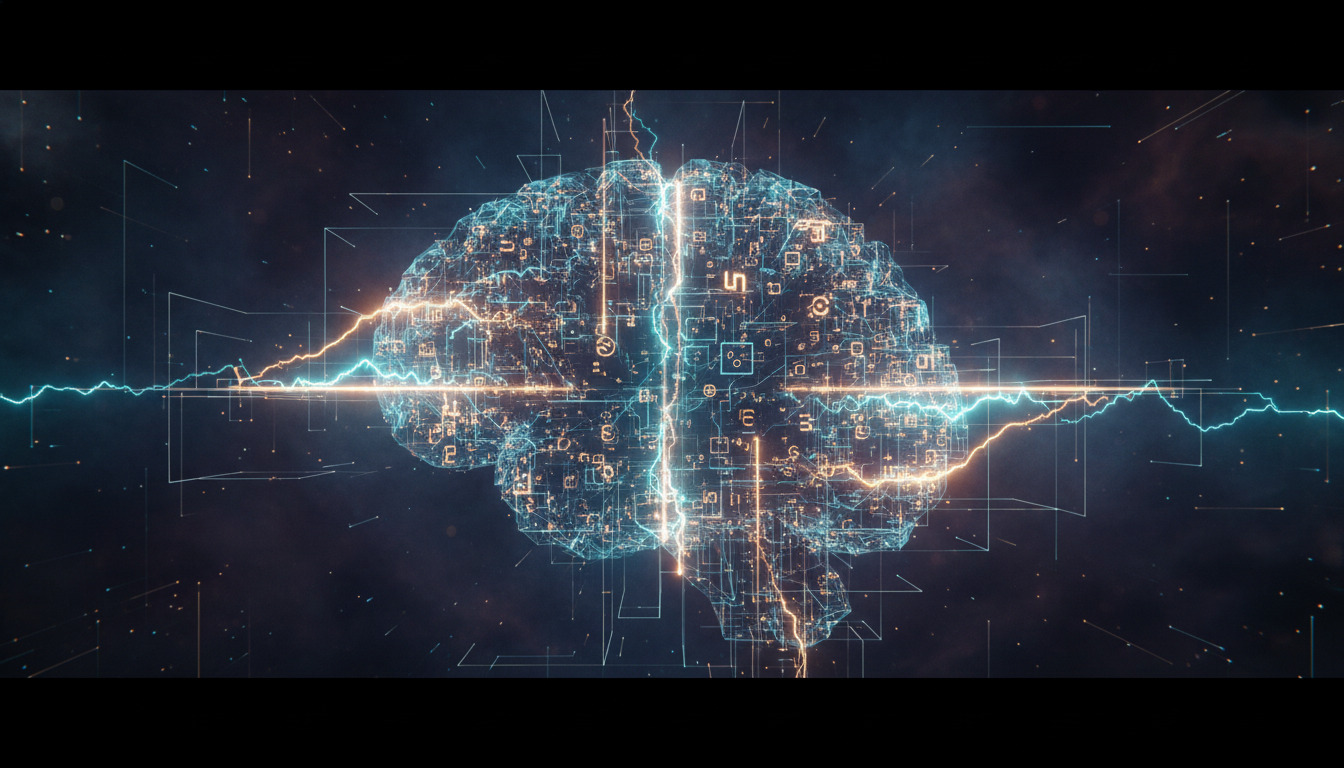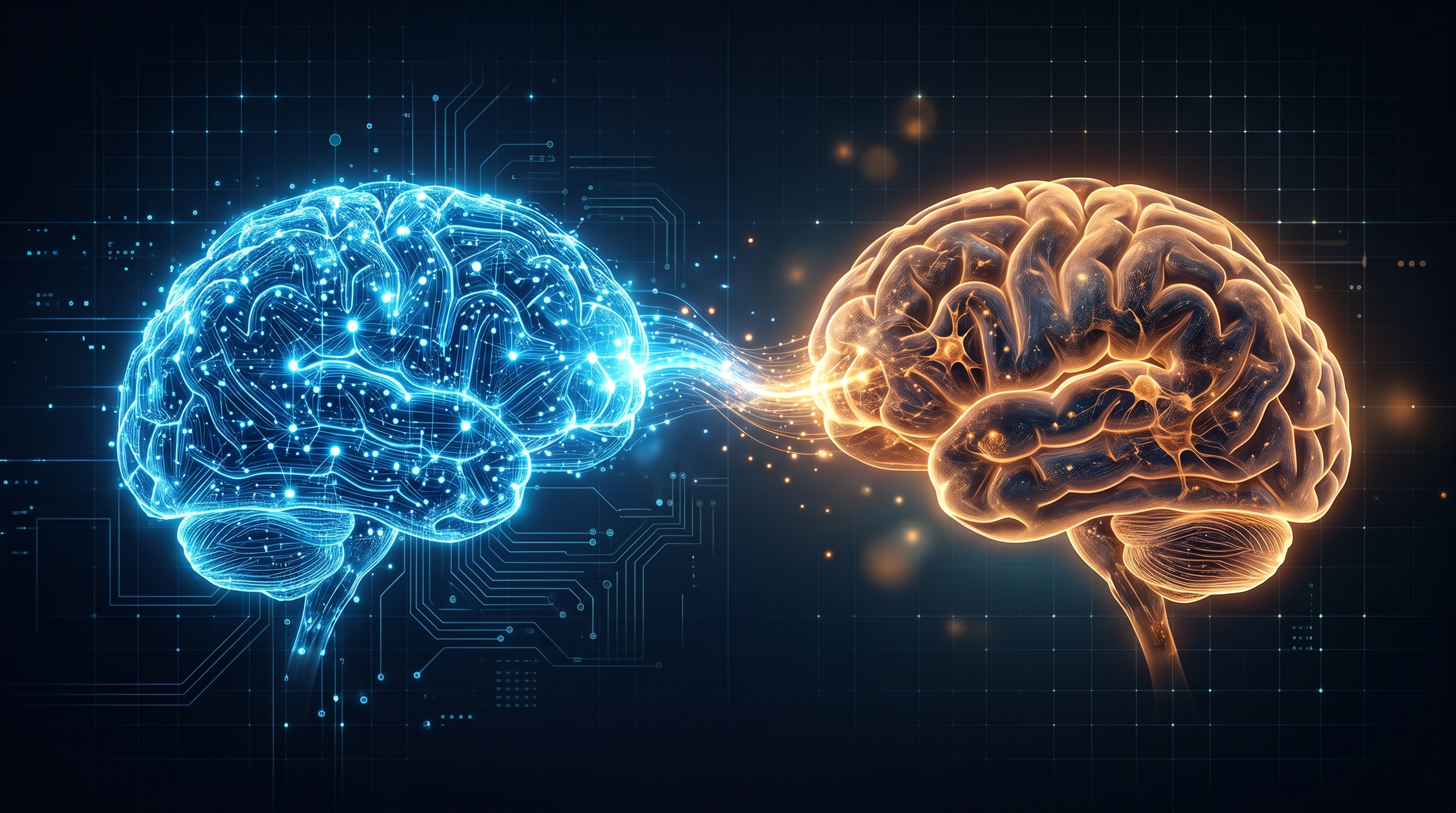
TL;DR: KAIST researchers found that the root cause of AI overconfidence isn't in the training data — it's in how neural networks are initialized. By adding a brief "warm-up" phase using random noise before any real training begins, they achieved a 34% improvement in calibration, making AI models significantly more honest about what they don't know. Published in Nature Machine Intelligence.
For a side-by-side view of where these tools land, our comparison database benchmarks the leading AI tools across every category.
The AI That Finally Learned to Say "I Don't Know": Inside the Brain-Inspired Breakthrough That Fixes Hallucination at the Root
The most dangerous thing about modern AI isn't that it gives wrong answers. It's that it gives wrong answers with absolute certainty.
Ask a large language model a question it doesn't know the answer to, and it won't shrug. It won't say "I'm not sure." Instead, it will fabricate something that sounds plausible — a phenomenon we've come to call "hallucination." This isn't a bug in any one model. It's a deep structural property of how almost every neural network is built.
But a team of researchers at the Korea Advanced Institute of Science and Technology (KAIST) may have just found the fix — [announced via the KAIST News Center](https://news.kaist.ac.kr/newsen/html/news/?mode=V&mng_no=61250) — and it's surprisingly elegant. The solution doesn't require more data, bigger models, or post-hoc filtering. It requires a brief moment of chaos before learning even begins.
The Calibration Problem
In machine learning, "calibration" is the alignment between what a model predicts and how confident it is in that prediction. A well-calibrated model that's 90% confident should be right 90% of the time. A poorly calibrated model will say "I'm 99% sure" while being wrong half the time.
This isn't an edge case. Modern deep neural networks — the kind that power everything from ChatGPT to self-driving car perception systems — are notoriously poorly calibrated. As models get larger and more capable, the problem often gets worse, not better.
The research community has known about this for years. Various fixes exist: temperature scaling, label smoothing, ensembling. But these are band-aids applied after training. They don't fix the underlying cause.
A Surprising Discovery: Random Initialization Is the Culprit
The KAIST team, led by Distinguished Professor Se-Bum Paik from the Department of Brain and Cognitive Sciences, made a startling observation: overconfidence already exists in a neural network before it learns anything at all.
Here's why this matters. Every deep neural network starts with randomly initialized weights. It's a convention so standard that most practitioners never question it. But when the researchers fed random noise into a freshly initialized network — a network that had literally learned nothing — it confidently assigned high probability to its random predictions.
"It's as if the network believes it knows something before it has seen any data," the researchers noted.
This initial overconfidence bias doesn't disappear during training. It propagates, amplifying with scale. By the time a model finishes training on billions of tokens, that original seed of overconfidence has become a structural feature of how it processes uncertainty.
The Brain's Answer: Spontaneous Neural Activity
To solve this, the team looked to biology. Specifically, they examined how the developing human brain handles uncertainty.
Before birth, the fetal brain generates spontaneous neural activity — electrical signals that fire without any external sensory input. These seemingly random signals aren't noise for noise's sake. They play a critical role in forming neural circuits and, crucially, establishing a baseline for how the brain will process its own uncertainty.
A newborn doesn't enter the world confident about everything. It enters confused, uncertain, and gradually learns to make sense of the world. That initial state of "I don't know" is fundamental to how real intelligence develops.
Epistemic Inoculation: The Warm-Up Phase
The researchers translated this insight into a training strategy they call the "warm-up phase" — or, as some coverage has dubbed it, "epistemic inoculation" : a small dose of chaos that teaches the network humility.
Here's how it works in practice:
- Before any real training begins, the neural network is briefly exposed to random noise — meaningless arbitrary input data paired with random labels.
- The network learns nothing useful from this phase. That's the point. Instead of learning patterns, it learns to recognize its own uncertainty.
- After the warm-up (typically a very short training cycle), the model's confidence is calibrated to a uniform chance level. It has effectively learned the state of "I don't know anything yet."
- Then, normal training on real data begins.
The difference is profound. In the standard configuration, a network starts training already biased toward overconfidence. With the warm-up, it starts from a neutral baseline. The overconfidence bias that normally compounds over thousands of training steps simply never emerges.
The Numbers
The results, [published in Nature Machine Intelligence](https://www.nature.com/articles/s42256-026-01215-x) on April 9, 2026, are compelling:
- Models trained with the warm-up phase showed a 34% improvement in calibration metrics compared to conventionally trained counterparts.
- Confidence and accuracy stayed aligned throughout the entire training process, rather than diverging as models scaled.
- The warm-up models demonstrated significantly better out-of-distribution detection — the ability to recognize when they're looking at something they haven't been trained on.
- The approach required negligible additional compute — the warm-up phase is orders of magnitude shorter than the main training run.
This last point is crucial. Many proposed fixes for hallucination and overconfidence involve architectural changes, additional validation steps, or post-hoc processing that adds latency and cost. The warm-up phase costs almost nothing.
Why This Matters Right Now
The timing of this research couldn't be more relevant. As of May 2026, AI systems are being deployed in increasingly high-stakes environments:
- Medical diagnosis: An overconfident AI misdiagnosis could lead to harmful treatment decisions. The warm-up approach directly improves reliability in the kind of edge cases where uncertainty matters most.
- Autonomous driving: Knowing what you don't know is arguably more important than knowing what you do know when navigating unpredictable road conditions.
- Financial risk assessment: Models that express calibrated uncertainty about market predictions are safer than models that express false certainty.
- Legal and compliance: AI systems reviewing contracts or regulations need to flag uncertainty, not confidently misinterpret clauses.
More broadly, this research challenges one of the most widely held assumptions in the AI community: that more data and more compute naturally produce better-behaved models. The KAIST team's work suggests that how you train — the sequence and structure of learning — matters as much as how much you train.
Beyond Calibration: The Path to AI Metacognition
Professor Paik described the broader implications in the [paper's press release](https://www.eurekalert.org/news-releases/1126727): "This study demonstrates that by incorporating key principles of brain development, AI can recognize its own knowledge state in a way that is more similar to humans. This is important because it helps AI understand when it is uncertain or might be mistaken, not just improve how often it gives the right answer."
The paper suggests that this approach could be a step toward metacognition in AI — the ability of a model to distinguish between what it knows and what it doesn't know. This is a fundamentally different capability from simply getting the right answer more often. It's the difference between a student who memorizes test answers and one who understands the limits of their own knowledge.
The research (DOI: 10.1038/s42256-026-01215-x) was also featured as a notable paper in Nature Machine Intelligence's News & Views section, with a companion article titled "Learning to be uncertain before learning from data" (DOI: 10.1038/s42256-026-01205-z).
The Takeaway
The AI industry has spent years chasing scale. Bigger models, more data, longer training runs. The implicit assumption has been that with enough of everything, better behavior will emerge naturally.
The KAIST team's insight turns this on its head. Sometimes the best way to make an AI smarter is to first teach it how little it knows.
For developers, startup founders, and engineers building AI products, this has a direct practical implication: when evaluating tools and frameworks for training, ask about calibration, not just accuracy. A model that confidently hallucinates is more dangerous than one that humbly admits uncertainty. The warm-up approach isn't just theoretical — it's a practical, low-cost adjustment that any training pipeline can adopt.
The AI that finally learned to say "I don't know" might turn out to be the most trustworthy one of all.
Dig deeper: How Google's Gemma 4 MTP Drafters Deliver 3x Faster AI… · The Warmth Trap: Why Friendly AI Chatbots Make More Mistakes.
References
[1] announced via the KAIST News Center [2] published in Nature Machine Intelligence [3] paper’s press release
📖 Related Reads
- ToolBrain — tool reviews, LLM comparisons, and AI workflow guides
- CodeIntel Log — code quality, debugging, and software engineering benchmarks
Cross-links automatically generated from None.
Back to all posts