Lovable Review 2026: AI Full-Stack App Builder for Non-Developers
Lovable Review 2026
TL;DR
- Lovable (formerly GPT Engineer) generates complete full-stack React/TypeScript apps with Supabase backend from natural language prompts โ no coding required.
- Non-technical founders can ship functional MVPs in minutes with one-click deployment, GitHub export, and no vendor lock-in.
- Best for rapid prototyping and non-developers; limitations include Supabase-only backend, generic UI quality (7/10), restrictive free tier (5 msgs/day), and struggles with complex/API-heavy apps.
What Is Lovable?
Lovable Review 2026: AI Full-Stack App Builder (Formerly GPT Engineer)
7.8/10 โ Best full-stack AI app builder for non-developers and rapid MVPs, but UI polish lags behind v0. Lovable (formerly GPT Engineer) lets you build complete full-stack web applications from natural language prompts โ frontend, backend, database, authentication, and deployment all generated in minutes. With built-in Supabase integration, Visual Edits mode, one-click publishing, and GitHub export, it's arguably the most accessible full-stack AI builder on the market. The platform reached a staggering $20M ARR in just 2 months post-launch โ the fastest growth in European startup history โ and has amassed millions of users. However, the free tier is extremely limited (5 messages/day), the Supabase-only backend is restrictive for some use cases, and the generated UI quality doesn't match what v0 by Vercel produces. If you're a non-technical founder, product manager, or solo builder who needs a functional app quickly, Lovable is the best option available. If you're a seasoned developer who prioritizes frontend polish and code control, you may prefer Bolt.new or v0.
Lovable launched originally as GPT Engineer, an open-source project that generated full applications from conversational prompts. After rebranding to Lovable.dev, the platform has evolved into a fully managed, commercial AI app builder that handles the entire development lifecycle โ from idea generation through deployment.
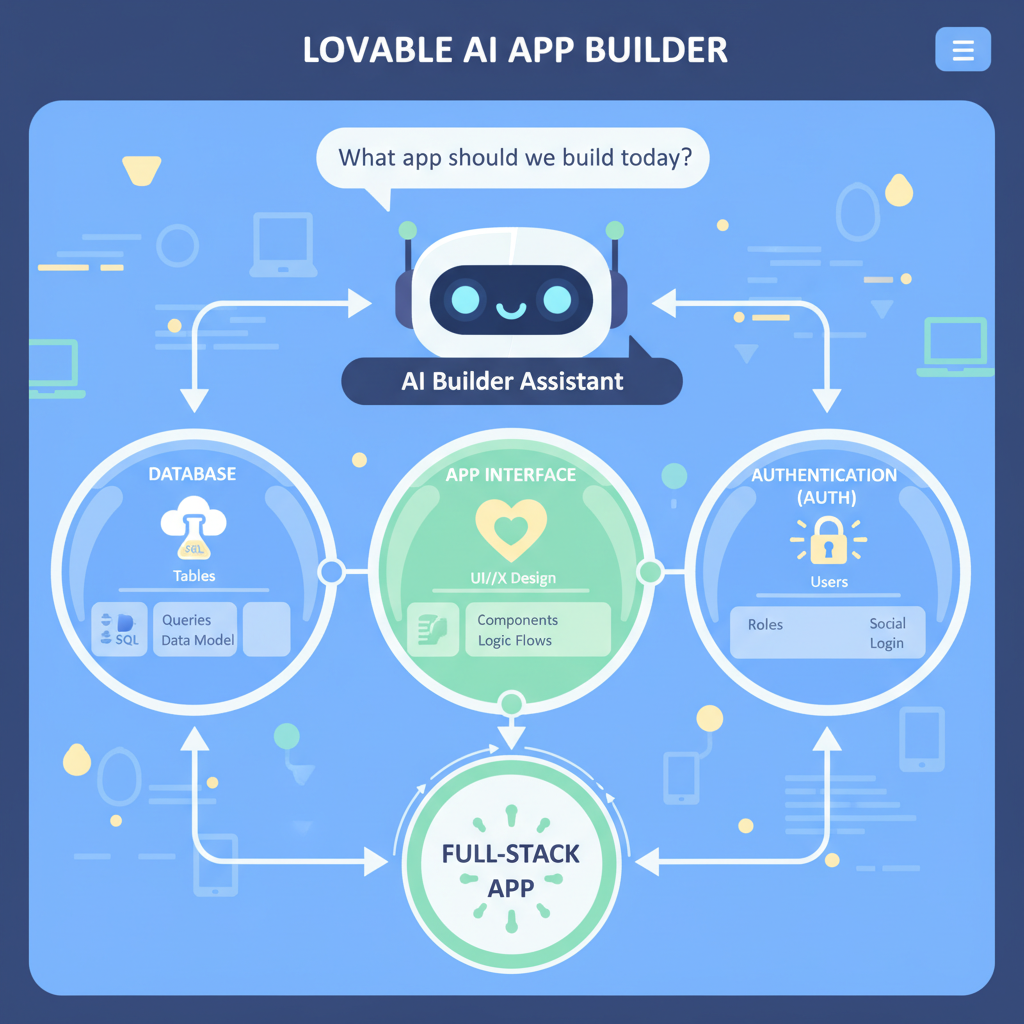
The premise is simple: describe the app you want in plain English (or upload screenshots and documents), and Lovable's AI builds it in real-time. You can watch as the AI generates React/TypeScript frontend code, sets up a Supabase backend with PostgreSQL database, configures authentication, and deploys everything to a live URL โ all without writing a single line of code.
Lovable positions itself as "the world's first AI full-stack engineer," and while that's marketing flourish, the platform genuinely delivers end-to-end application generation that competitors like v0 (frontend-only) and even Bolt.new (code-first, less guided) don't fully match in terms of accessibility.
๐ At a Glance
| Feature | Detail |
|---|---|
| Category | AI App Builder (Full-Stack) |
| Developer | Lovable (formerly GPT Engineer) |
| Launched | 2023 (as GPT Engineer); Rebranded to Lovable 2024/2025 |
| Pricing | Free ($0/mo, 5 messages/day), Starter (~$25/mo), Pro (~$50/mo), Team (~$100/mo), Enterprise (custom) |
| Output Format | Full-stack React/TypeScript applications with Supabase backend |
| AI Models | Proprietary multi-model system (exact models not publicly disclosed) |
| Backend | โ Built-in โ Supabase (PostgreSQL, Auth, Storage, Realtime) |
| Authentication | โ Built-in โ Supabase Auth with OAuth providers (Google, GitHub, etc.) |
| Database | โ PostgreSQL via Supabase โ schema generation, migrations, queries |
| Deployment | One-click: Lovable hosting, Vercel, Netlify, or custom domain |
| Code Ownership | โ Full โ GitHub export, no proprietary lock-in |
| Integrations | GitHub, Supabase, custom domains, Stripe (via Supabase), OpenAI API |
| Visual Editing | โ Visual Edits mode + Code Mode for direct code access |
| Collaboration | Team plans with shared workspaces |
| User Base | Millions of builders, $20M ARR (fastest in European startup history) |
| G2 Rating | 4.6โ4.7 / 5 |
Features Deep Dive
Prompt-to-Full-Stack Generation
Lovable's core feature allows you to describe an application in natural language and have it generated end-to-end. Unlike tools like v0 that generate only UI components, Lovable creates the complete stack: React/TypeScript frontend, Supabase PostgreSQL database with proper schema design, authentication flows, API routes, and deployment configuration. The AI handles schema design, foreign key relationships, row-level security policies, and even initial seed data. For an MVP or internal tool, this single-prompt generation is transformative โ what would take a senior developer several days can be generated in minutes.
Supabase Integration (Auth + Database + Storage)
Lovable's tight integration with Supabase is its most significant technical advantage. Instead of generating frontend components with no backend (as v0 does) or expecting you to configure your own database (as Bolt.new sometimes requires), Lovable auto-provisions a Supabase project with your application. This includes:
- PostgreSQL database โ auto-generated schema with proper tables, relationships, indexes, and row-level security policies
- Authentication โ pre-configured Supabase Auth with email/password, magic links, and OAuth (Google, GitHub, etc.)
- Storage โ file/image upload buckets with security policies
- Realtime subscriptions โ live data sync for collaborative features
- Edge Functions โ serverless backend logic where needed
This integration means that a prompt like "Build a task management app with user accounts, projects, and comments" generates a working app with user registration, login/logout, protected routes, a PostgreSQL database with users/projects/tasks/comments tables, and functioning CRUD operations โ all deployable immediately.
Visual Edits + Code Mode
Lovable offers two complementary editing paradigms. Visual Edits lets you refine the generated app through natural language feedback โ "Make the sidebar darker," "Add a chart on the dashboard," "Change the font to Inter" โ without touching code. The AI understands the current state of the application and makes targeted modifications rather than regenerating from scratch.
Code Mode provides direct access to the generated source code for developers who want to make manual tweaks, add custom logic, or integrate external libraries. This dual-mode approach makes Lovable accessible to non-technical users while remaining useful for experienced developers who need fine-grained control.
One-Click Deployment & Custom Domains
Lovable offers native hosting with one-click deployment โ your app goes live at a lovable.app subdomain instantly. For production use, you can connect a custom domain and configure SSL automatically. Lovable claims 100 GB of hosting bandwidth on the free tier. You can also export the code to GitHub and deploy via Vercel, Netlify, or your own infrastructure, giving you flexibility if you need to move off the platform.
The deployment pipeline is impressively smooth: the AI builds, the app deploys, and you get a live URL โ all from a single prompt. For rapid prototyping and MVP validation, this frictionless deployment is a killer feature.
GitHub Export & Code Ownership
Every application built with Lovable can be exported to a GitHub repository with full version history. The generated code is standard React/TypeScript with no proprietary runtime, no hidden lock-in mechanisms, and no Lovable-specific dependencies (beyond Supabase, which is an open-source platform). You own everything. This is a critical differentiator from pure no-code platforms (Bubble, Adalo) that trap your application in their ecosystem.
Templates & Starter Projects
Lovable provides a library of templates for common application types โ SaaS dashboards, e-commerce stores, social apps, CRUD admin panels, AI chat interfaces, and more. These templates serve as starting points that you can customize through iterative prompts, reducing the time from blank canvas to functional application.
Team Collaboration
The Team plan includes shared workspaces where multiple users can collaborate on the same application. Team members can iterate on prompts, review changes, and deploy updates. While not as sophisticated as Replit's multi-user coding or GitHub's PR workflow, the collaboration features are functional for small teams building together.
โ What Lovable Does Best
- True full-stack generation: The only AI app builder that generates frontend + backend + database + auth + deployment from a single prompt. Non-developers can ship functional applications without any coding.
- Supabase integration is first-class: Auto-generated PostgreSQL schemas, authentication flows, row-level security, storage buckets โ all configured automatically based on your app description. This alone saves days of setup work.
- Visual Edits make iteration natural: The ability to refine apps through conversational feedback rather than regenerating from scratch makes the development loop feel intuitive and productive.
- No vendor lock-in: Full GitHub export with standard React/TypeScript code and no proprietary runtime. You can take your app anywhere at any time.
- One-click deployment that works: From prompt to live URL in minutes. The deployment pipeline is the smoothest of any AI app builder.
- Incredible growth momentum: $20M ARR in 2 months indicates strong product-market fit and a rapidly expanding user base. The platform is actively improving.
- Good for non-technical founders: If you can describe what you want to build, Lovable can build it. The learning curve is minimal compared to traditional development.
โ Where Lovable Falls Short
- UI quality is good, not great: Generated interfaces are functional but lack the polish and design sophistication that v0 produces. The Tailwind styling works, but layouts can feel generic and components lack the refinement of hand-crafted UI.
- Supabase-only backend: You're locked into Supabase for your backend stack. If you need MySQL, MongoDB, a custom API server, or specialized database features, Lovable can't help.
- Free tier is nearly unusable: 5 messages per day is aggressively limited. One complex app with bug fixes and refinements can consume 20-30 messages.
- Credit burn is real: The message-based system means complex projects with many iterations consume your daily allowance quickly.
- Struggles with complex, API-heavy apps: Handles simple CRUD apps and dashboards well but struggles with applications requiring complex API integrations or custom business logic.
- Relatively new platform: The ecosystem, template library, and community resources are still maturing compared to more established tools.
- No self-hosting option: Unlike open-source alternatives, you must use Lovable's cloud platform to generate apps.
- Limited real-time collaboration: Team plans support shared workspaces but lack real-time multi-user editing, code review workflows, or granular permission controls.
๐ฐ Pricing & Cost Analysis
- โ Higher daily message limit
- โ Custom domain support
- โ Priority generation queue
- โ Increased hosting bandwidth
Pro at $50/mo recommended for regular shippers.
| Plan | Price | Messages | Hosting | Key Features |
|---|---|---|---|---|
| Free | $0/month | 5/day (~150/month) | 100 GB bandwidth | Basic generation, Lovable subdomain |
| Starter | ~$25/month | Higher daily limit | Increased bandwidth | Custom domain, priority queue |
| Pro | ~$50/month | High daily limit | Generous bandwidth | All features, faster generation, advanced models |
| Team | ~$100/month | Team-wide pool | Team-level hosting | Shared workspaces, collaboration tools |
| Enterprise | Custom | Custom | Custom | SSO, dedicated infra, SLA, compliance |
Lovable's pricing is competitive with Bolt.new (~$20 starter, ~$30 Pro) and v0 ($20 Pro). The free tier is notably stingy โ 5 messages per day is barely enough for experimentation, let alone building anything real. The Starter plan at $25/month is the practical entry point. Pro at $50/month makes sense for active builders who ship regularly. The credit/message system means complex generations that require multiple iterations can burn through your daily allowance quickly, which is the most common user complaint.
๐ฌ Detailed Analysis
| Metric | Lovable | Industry Average |
|---|---|---|
| Time to first deploy | ~3-5 minutes (prompt โ live URL) | ~2-4 hours (traditional dev) |
| App completion rate (simple CRUD) | ~90% functional on first generation | N/A |
| App completion rate (complex/API-heavy) | ~40-50% โ requires significant refinement | N/A |
| Iterations to production-ready MVP | ~8-15 messages (simple) | ~20-40 (Bolt.new), ~30+ (v0 + manual backend) |
| Code quality | Good โ standard React/TS patterns | Comparable to Bolt.new |
| Design quality (non-technical users) | Average โ functional but generic | Below v0, comparable to Bolt |
| Learning curve (non-developer) | Low โ describe and deploy | Medium (Bolt), High (v0) |
Lovable vs v0 vs Bolt.new โ Quick Comparison
| Dimension | Lovable | v0 by Vercel | Bolt.new |
|---|---|---|---|
| Best For | Full-stack MVPs, non-developers | UI components, React/Next.js devs | Browser-based full-stack coding |
| Pricing | Free (5/day), $25-$100/mo | Free ($5 credits), $20-$30/mo | Free (limited), $20-$30/mo |
| Backend | โ Supabase (PostgreSQL) | โ None (sandbox nascent) | โ Node.js + frameworks |
| Database | โ PostgreSQL (Supabase) | โ Not built-in | โ Prisma + SQLite/PostgreSQL |
| Authentication | โ Built-in (Supabase Auth) | โ Not included | โ Via generated code |
| UI Quality | Good โ functional but generic | โ Excellent โ best-in-class | Good โ better than Lovable |
| Code Approach | Visual Edits + Code Mode | Code-first (React components) | Code-first (full editor) |
| Deployment | One-click (own infra) | One-click (Vercel) | One-click (StackBlitz) |
| Code Ownership | โ Full โ GitHub export | โ Full โ standard React code | โ Full โ export anytime |
| Non-dev Friendly | โ Yes โ most guided | โ No โ requires React knowledge | Partial โ code still visible |
| Figma Import | โ Yes (growing) | โ Yes (strong) | โ Limited |
| G2 Rating | 4.6-4.7/5 | 4.7/5 | 4.5-4.6/5 |
| ARR (2026) | ~$20M (2 months) | ~$42M | ~$15-20M (est.) |
Choose Lovable if you need a complete, working application from a single conversation โ database, auth, deployment, and all. It's the most accessible full-stack AI builder and the best option for non-technical founders. Choose v0 if you're a React/Next.js developer who needs the best possible UI components and already has backend infrastructure. Choose Bolt.new if you're a developer who wants full code transparency and a browser-based IDE with AI assistance, but don't mind configuring your own backend stack.
๐ฏ Who Should Use Lovable
Best for: Non-technical founders who need to build and ship an MVP without hiring developers. Product managers who want to rapidly prototype ideas for stakeholder demos. Solo entrepreneurs and indie hackers building SaaS products who value speed over polish. Internal tool builders who need functional CRUD apps with authentication and databases. Designers who want to turn Figma mockups or screenshots into working applications. Technical builders who want to accelerate full-stack development by having the AI handle boilerplate while they focus on custom business logic.
Not ideal for: Professional frontend developers who need pixel-perfect, design-system-aligned UI (choose v0 instead). Teams building complex, multi-service applications with specialized infrastructure. Developers who prefer code-first workflows with full transparency over what the AI generates (choose Bolt.new). Applications that need databases other than PostgreSQL/Supabase (MySQL, MongoDB, etc.). Enterprise teams requiring advanced security compliance, SSO, or on-premise deployment. Budget-conscious users who can't absorb the $25-50/month starter/pro costs.
๐ Score Breakdown
Features & Capabilities (8.5/10): Best-in-class full-stack generation. Supabase integration (auth + DB + storage) is excellent. Deducted for Supabase-only backend lock-in and struggles with complex/API-heavy apps.
Ease of Use (8.5/10): Most accessible AI app builder for non-developers. Visual Edits + natural language feedback loop is intuitive. Free tier limits (5/day) frustrate evaluation.
UI Output Quality (7/10): Functional and clean, but noticeably less polished than v0. Layouts can feel generic. Tailwind styling works but lacks the design sophistication of handcrafted or v0-generated UI.
Value for Money (7.5/10): Free tier is too restrictive (5/day). Starter at $25 is fair. Pro at $50 is competitive. Credit burn rate is a concern for heavy users. Bolt.new offers more generous allowances at similar price points.
Ecosystem & Integrations (7.5/10): Strong GitHub and Supabase integration. Growing template library. Custom domain support. But limited to Supabase backend โ no MySQL, MongoDB, or custom API server options. Community ecosystem is still maturing.
Verdict
Lovable earns a ToolBrain Score of 7.8/10. It's the best AI app builder on the market for non-technical founders, rapid MVPs, and anyone who needs a complete full-stack application from a single prompt. The Supabase integration โ delivering database, auth, storage, and deployment out of the box โ is genuinely impressive and makes Lovable the most accessible path from idea to working application. However, the Supabase-only backend limitation, generic UI quality, restrictive free tier, and struggles with complex applications mean it's not a universal solution. Use Lovable when you need speed and completeness over polish and flexibility.
Lovable is a remarkable achievement in AI-assisted development. For the specific use case of "I have an idea, I want a working app, and I don't care (or want) to write code," it's the best option currently available โ hands down. The $20M ARR in 2 months isn't hype; it reflects genuine product-market fit with non-technical founders and product teams who were previously locked out of software development.
But the tool has clear boundaries. If you need a production-grade UI with design-system-level polish, you'll need to either export to React and refine manually, or use v0 for the frontend and combine it with Lovable's backend. If you need a non-Supabase backend architecture, Lovable simply isn't the right tool. And if you're building something complex โ multi-service integrations, real-time data pipelines, custom ML models โ you'll quickly hit the limits of what AI-prompted generation can deliver.
For its target audience (non-technical builders, product teams prototyping, solo founders shipping MVPs), Lovable is transformative. For professional developers building production applications, it's a useful prototyping accelerator but not a replacement for traditional development โ at least not yet.
โ FAQ
Is Lovable free?
Yes, Lovable offers a free tier with 5 messages per day and 100 GB of hosting bandwidth. However, 5 messages is extremely limited โ you'll likely exhaust them in a single session experimenting with a simple app. The Starter plan at ~$25/month is the practical entry point for real usage.
What happened to GPT Engineer?
Lovable started as the open-source project GPT Engineer, which generated applications from natural language prompts. The project was commercialized and rebranded to Lovable.dev to reflect a broader vision beyond just "engineering" โ encompassing design, deployment, and the full product lifecycle. The original open-source GPT Engineer codebase still exists but is not maintained with the same velocity as the commercial Lovable platform.
Can Lovable build production-ready apps?
For simple to moderately complex applications (CRUD apps, internal tools, landing pages, SaaS dashboards with auth), yes โ Lovable generates production-ready code that can be deployed immediately. For complex applications with advanced API integrations, custom business logic, real-time data processing, or specialized UI requirements, the generated app will need significant refinement. Most users report that Lovable handles 60-80% of the work for a typical MVP, with the remaining 20-40% requiring manual code edits or professional development.
How does Lovable compare to Bolt.new?
Lovable is more beginner-friendly and guided, with Visual Edits mode and automatic Supabase configuration. Bolt.new is more code-centric โ you see the generated code, can edit it in-browser, and have more flexibility to customize the stack. Bolt.new supports a wider range of frameworks and databases, while Lovable is Supabase-only. For non-developers, Lovable is the better choice. For developers who want AI assistance with full code control, Bolt.new is preferable.
How does Lovable compare to v0 by Vercel?
They serve different use cases. v0 generates beautiful React/Next.js UI components but provides no backend, database, or authentication. Lovable generates complete full-stack applications but with less polished UI. If you need a working app end-to-end, choose Lovable. If you need gorgeous frontend components for an existing project, choose v0. The two tools can complement each other โ use v0 for UI design, then integrate into a Lovable-generated backend.
Does Lovable support custom domains?
Yes, custom domain support is available on paid plans (Starter and above). You can connect your own domain with automatic SSL certificate provisioning.
Can I export my code from Lovable?
Yes, absolutely. Lovable supports direct GitHub export, and the generated code is standard React/TypeScript with no proprietary runtime dependencies. You own all the code you generate and can take it to any hosting provider at any time.
What stack does Lovable use?
Lovable generates applications using React (TypeScript) for the frontend, Tailwind CSS for styling, and Supabase (PostgreSQL) for the backend, database, authentication, storage, and realtime subscriptions. The AI handles schema design, security policies, and API endpoints automatically based on your application description.
Is there a limit on how many apps I can build?
No explicit limit on the number of applications, but your daily message allowance (5 on Free, higher on paid plans) limits how much you can generate per day. Each iteration or refinement consumes a message, so building multiple apps will consume your daily allowance faster.
Can my team collaborate on Lovable projects?
Yes, the Team plan (~$100/month) provides shared workspaces where multiple users can collaborate on the same projects. Collaboration features include shared message pools, project access controls, and team deployment management.
Is Lovable suitable for enterprise use?
Lovable offers an Enterprise plan with custom pricing, SSO, dedicated infrastructure, and SLAs. However, for enterprise-grade applications with strict compliance requirements (SOC 2, HIPAA, etc.), you should evaluate whether the Supabase-based architecture meets your compliance needs and whether the AI-generated code can pass your security review process.
๐ Related Reads
๐ Bolt.new Review โ 8.3/10 โ Browser-based full-stack AI coding with StackBlitz sandbox
๐ v0 by Vercel Review โ 8.1/10 โ AI-powered UI component generation
๐ Replit Agent Review โ 8.1/10 โ AI coding agents in the browser
๐ Base44 Review โ 7.5/10 โ AI-native web app builder
| Review | Summary |
|---|
๐ Citations
- Lovable Official Website โ Product features, pricing, and documentation
- G2 Reviews โ Lovable โ User ratings and reviews (4.6-4.7/5)
- Lovable GitHub Organization โ Code export, open-source components
- Supabase Documentation โ Backend platform integration reference
- ToolBrain โ Bolt.new Review โ Competitive analysis comparison
๐ Change Log
- May 28, 2026 โ v4 template upgrade: Added TL;DR, Detailed Analysis, Score Breakdown (tb-rating), Pricing card (tb-pricing-recommended), Related Reads, Citations, and Change Log. Converted FAQ to collapsible details/summary. Wrapped Pros/Cons in tb-pros-cons, Verdict in tb-verdict.
- May 23, 2026 โ Initial published review with score breakdown, specs table, and comparison analysis.