Verdict Up Front
Beginners who want a single-connection, well-documented voice agent stack (STT + LLM + TTS over one WebSocket) at a transparent per-minute rate should start here. Developers who need verified latency/accuracy benchmarks, or a self-hosted deployment without an Enterprise contract, should look elsewhere (and see our Retell/Vapi reviews).
The headline number is simple: Deepgram markets its Voice Agent API at $4.50 per hour on the product page (Deepgram Voice Agent API product page). That figure is arithmetic you can check — the current pay-as-you-go Standard rate is $0.075 per minute, and $0.075 × 60 minutes = $4.50 (Deepgram Pricing).
One important disclaimer before we go further: this review is documentation-based. We did not run the tool hands-on, so every performance-adjacent number below is either quoted from Deepgram’s own pages or explicitly flagged as unverified. We return to that in “How This Guide Was Built.”
Three quick beginner definitions, since this is an API product and the acronyms come fast:
- STT (speech-to-text): converts what the caller says into written text the software can process.
- LLM (large language model): the reasoning engine that decides what the agent should say next, including whether to call a tool.
- TTS (text-to-speech): turns that written reply back into the voice the caller hears.
What the Voice Agent API Actually Is
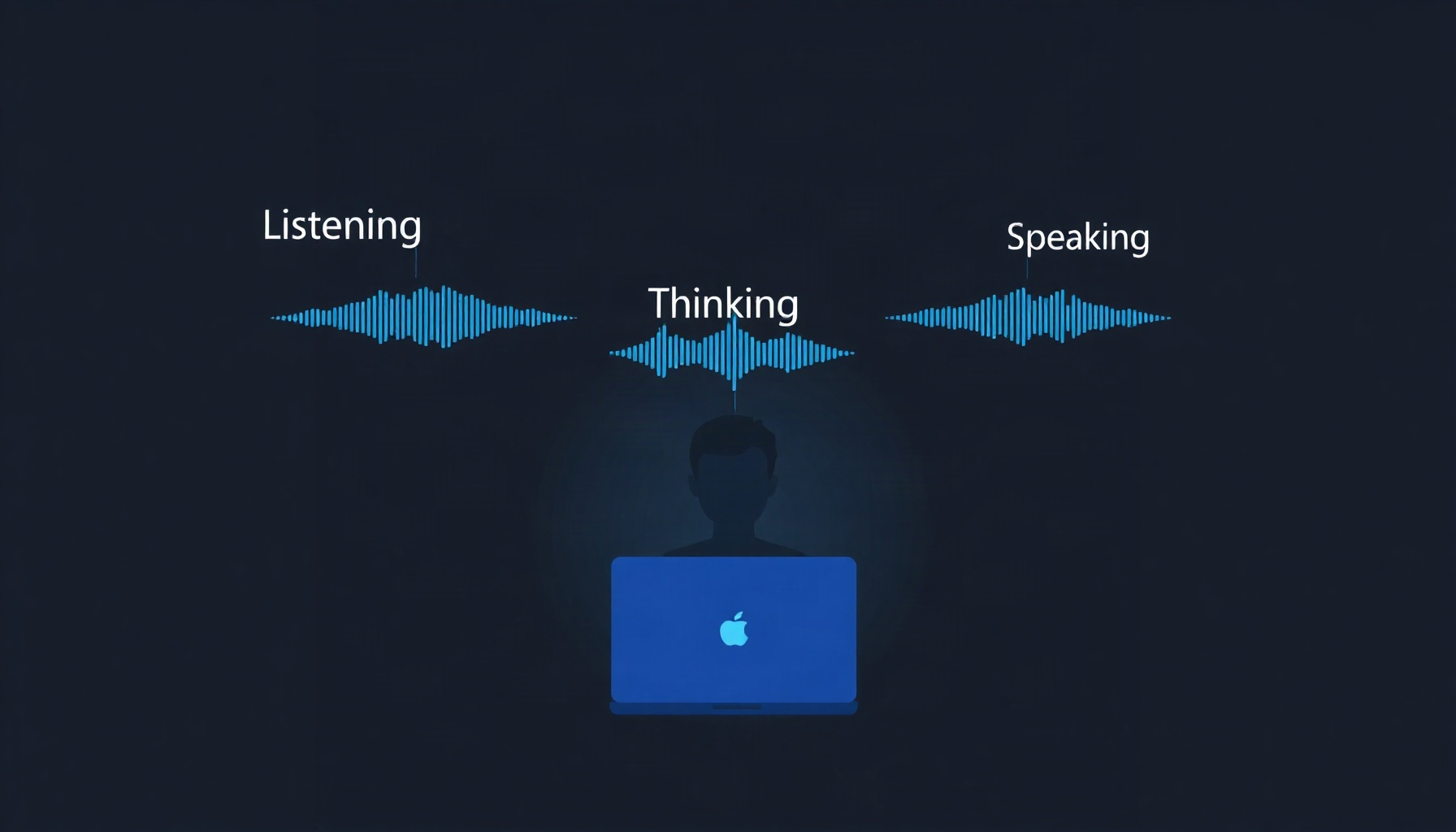
Most beginner voice projects start as three separate services glued together: one vendor for STT, a model for the thinking, and a voice for TTS. Deepgram’s Voice Agent API collapses that into one managed session. It handles listening (STT), thinking (LLM) and speaking (TTS) over a single WebSocket connection (Deepgram Voice Agent docs).
A WebSocket is a persistent, two-way connection between your app and the server that stays open during the whole conversation, so audio can flow in and replies can flow back continuously — unlike a normal web request, which opens, delivers, and closes.
The documented endpoint is wss://agent.deepgram.com/v1/agent/converse. Deepgram also lists regional endpoints for the EU (api.eu.deepgram.com), Australia (api.au.deepgram.com) and India (api.in.deepgram.com) — relevant if data residency matters to you or your customers (Deepgram Voice Agent docs).
In practice, this makes Deepgram an orchestrator: you are not just buying speech recognition, you are buying a managed conversation loop. That is a meaningfully different product category from raw transcription APIs, and it is why we file it under Voice AI Agent Platform.
How You Build It: The Four-Step Flow
Deepgram documents a four-step construction path (Deepgram Voice Agent docs):
- Open the connection to the WebSocket endpoint.
- Send a Settings message specifying models, voices and agent behavior.
- Stream raw audio from the user’s microphone (or a telephony media stream) into that connection.
- Handle the events that come back — transcripts (what was said), agent responses (what the agent decided), and audio output (the spoken reply).
Deepgram states the usage rule plainly in its build guide: you are billed on WebSocket connection time, and one hour of connection time equals one hour of usage (Build a Voice Agent). That single sentence drives most of the cost math later in this article. A call that stays connected for five minutes bills as five minutes, whether or not anyone is speaking.
Official tutorials exist for the Python, JavaScript, C# and Go SDKs (Build a Voice Agent), and there are separate pages for configuring a voice agent, function calling (letting the agent trigger your own code, like booking a slot or checking an order), and choosing LLM models. A full API reference for Voice Agent is published for exact message schemas.
Two honest notes on the documentation: rate limits are handled by pointing to an API rate-limits reference page, with no fixed number stated on the Voice Agent pages we fetched. And the pricing page lists only Community & Discord support channels and a “Standard Uptime” SLA, with priority support reserved for Growth — we score support on that basis below.
Features You Get (and Which Ones Are Vendor Claims)
Separating documented capability from marketing language matters in this category, so here is the split.
Documented in the developer docs (Deepgram Voice Agent docs): function calling, multi-agent architecture with handoffs (one agent can pass the caller to another), reusable configurations, inbound telephony, a Browser Agent SDK, a prompting guide, and template apps. There is a dedicated inbound telephony agent walkthrough, whose reference implementation uses Twilio.
Claimed on the product marketing page (product page): built-in barge-in detection (the caller can interrupt and the agent stops), turn-taking prediction, mid-session control, and deployment options ranging from fully managed to dedicated single-tenant, in-VPC, and self-hosted, with HIPAA and GDPR mentioned. These are plausible and consistent with how such platforms usually work, but on this site they are vendor claims, not verified findings — we did not test them.
The same caution applies to the customer testimonials on that page (Aircall, Jack in the Box, OpenPhone, StreamIt). Testimonials are vendor marketing, not independent evidence, and we treat them as such.
Pricing: What It Costs in 2026
All rates below are per minute and billed on WebSocket connection time. Source: Deepgram Pricing, fetched 2026-10-17.
| Tier | Pay As You Go | Growth |
|---|---|---|
| Standard | $0.075/min | $0.068/min |
| Standard, BYO TTS | $0.065/min | $0.051/min |
| Custom, BYO LLM | $0.059/min | blank on fetched page |
| Custom, BYO LLM + TTS | $0.050/min | $0.041/min |
| Advanced | $0.163/min | $0.146/min |
| Advanced, BYO TTS | $0.122/min | $0.110/min |
Reading that table:
- Standard Pay As You Go: $0.075/min, i.e. $4.50/hr — the headline rate.
- Growth Standard: $0.068/min. The Growth plan is described on the pricing page as “$4K+/year” with “save up to 20%” and pre-paid credits. Those are plan terms you should confirm before comparing against another vendor’s list price.
- BYO (bring your own) is cheaper. If you already pay for an LLM or a voice, Deepgram discounts accordingly: BYO TTS at $0.065/min, BYO LLM at $0.059/min, and both at $0.050/min (PAYG). Deepgram documents BYO LLM and BYO TTS support on the product page and LLM model docs.
- Advanced is the higher-priced tier at $0.163/min PAYG / $0.146/min Growth, more than double Standard. The pricing page does not spell out its feature difference, so compare it on the models you need.
- The Growth BYO-LLM cell was blank on the page we fetched. We state that as a gap rather than guessing a number.
A price-change warning you should not skip. A third-party guide records that the PAYG Standard rate was $0.056/min through 2026-09-12, rising to $0.075/min from 2026-09-13 (Thunderphone Deepgram pricing guide, sources accessed 2026-09-10). The current pricing page confirms $0.075/min. Any article still quoting $0.056/min as current is outdated. That is a ~34% increase on the entry rate, and it is exactly why this review pins every number to a fetch date.
Promotions. The Flux TTS free promotion inside Voice Agent ended 2026-09-12 (Thunderphone guide). The current pricing page instead offers matching credits: for every $1 spent on Flux TTS, Deepgram adds $1 in credits, up to $500, ending December 31, 2026 (Deepgram Pricing). Check the terms before you count on it.
Starting costs and refunds. Deepgram’s pricing page advertises a $200 credit on Pay As You Go sign-up, with no credit card required — a low-friction way to prototype. Unused credits are refundable if purchased within the last 30 days; credits are account-bound, and promotional credits are non-transferable.
Concurrency. The pricing page lists per-endpoint concurrency, including Voice Agent WSS up to 45 concurrent sessions on Pay As You Go and up to 60 on Growth (Deepgram Pricing). The Thunderphone guide says the pricing page publishes no concurrency limit; the current page does list them, so that guide is out of date on this point. These are published allowances, not tested throughput, and we did not verify them.
Cost-Per-Call: A Worked Example
This is illustrative arithmetic, not a quote and not a prediction of your bill. It uses only the Standard PAYG rate of $0.075/min and the connection-time billing rule.
Say you run 100 calls per month at 5 connected minutes each:
- 100 calls × 5 minutes = 500 connected minutes
- 500 × $0.075 = $37.50 per month
- That is $0.375 per 5-minute call in Deepgram API cost
Two things that number does not include. First, telephony is extra: you need a phone number and a carrier path. As an illustrative third-party reference (accessed 2026-09-10, not a quote), Thunderphone’s guide prices Twilio US inbound local voice at $0.0085/min, Twilio Media Streams at $0.0044/min for the reference path, and a Twilio local number at $1.15/month (Twilio US Voice pricing, Twilio Voice pricing). Deepgram’s own inbound telephony reference implementation uses Twilio, so that pairing is the documented default path. Second, your LLM costs are separate unless you use Deepgram’s bundled model — which is precisely what the BYO tiers are priced for.
For the full stack math (numbers, carriers, per-call economics end to end), use our dedicated voice AI phone agent cost post rather than the simplified example above.
Scores at a Glance
| Dimension | Score | Basis |
|---|---|---|
| Ease | 8/10 | Four-step flow plus official tutorials for Python, JavaScript, C# and Go (Build a Voice Agent) |
| Features | 8/10 | Function calling, multi-agent handoffs, inbound telephony, BYO LLM/TTS, and multiple deployment options claimed (docs + product page) |
| Performance | 5/10 | not benchmarked: documentation-based review — latency, accuracy and concurrency were not independently verified in this article |
| Docs | 9/10 | SDK tutorials, prompting guide, template apps, regional endpoints, function-calling and LLM-model guides (docs) |
| Support | 6/10 | Community & Discord channels and a “Standard Uptime” SLA listed; priority support is a Growth feature; no published response times (pricing) |
| Overall Score | 7/10 | Strong documentation and clear pricing; performance unproven for us |
Where It Fits vs. the Other Voice AI Tools
Deepgram occupies a specific spot: an orchestrator-style, single-WebSocket stack aimed at builders who want STT + LLM + TTS handled in one documented session with a per-minute rate you can compute. If you are still deciding what category of tool you even need, start with our best voice AI tools roundup for 2026, which positions Deepgram against the wider field. If your real question is “what does a phone agent cost once telephony is included,” read the voice AI phone agent cost post before you commit — the API rate is usually the smaller half of the bill.
If you are comparing specific platforms, we have reviewed two common alternatives in depth: Retell AI and Vapi. The short version of the positioning: Deepgram gives you a single-connection managed loop with published per-minute rates; the alternatives differ on how much orchestration control and how much multi-vendor flexibility you get. None of those differences should be decided on performance claims you cannot verify — including ours.
At a Glance
| Category | Voice AI Agent Platform |
|---|---|
| Best for | Builders wanting one documented connection for STT + LLM + TTS |
| Entry price | $0.075/min PAYG Standard ($4.50/hr) |
| Billing unit | WebSocket connection time |
| Free start | $200 credit, no credit card required |
| Main caveat | Latency/accuracy not independently verified here |
FAQ
How is the Deepgram Voice Agent API billed? On WebSocket connection time: one hour of connection time equals one hour of usage (Build a Voice Agent). The Standard Pay As You Go rate is $0.075/min, which works out to $4.50/hr (Deepgram Pricing).
Can I bring my own LLM or TTS? Yes. Per the pricing page: BYO TTS is $0.065/min PAYG, BYO LLM is $0.059/min, and both together are $0.050/min. The Growth equivalents listed are $0.051/min and $0.041/min; the Growth BYO-LLM cell was blank on the page we fetched.
Did the price change recently? Yes. The PAYG Standard rate moved from $0.056/min through 2026-09-12 to $0.075/min from 2026-09-13, per Thunderphone’s guide (accessed 2026-09-10) and confirmed by the current pricing page. Older articles citing $0.056 are outdated. The earlier Flux TTS free promotion ended 2026-09-12; a matching-credits offer (up to $500, ends 2026-12-31) now applies.
Is there a free tier? Not a permanent free tier, but the pricing page advertises a USD 200 credit on Pay As You Go sign-up with no credit card required. Unused purchased credits are refundable within 30 days; promotional credits are non-transferable.
What about actual phone calls? Deepgram documents an inbound telephony agent whose reference implementation uses Twilio, so phone numbers, carriers and media streaming are extra cost. See our cost-per-call post for the full stack.
The Bottom Line
The thesis holds: if you want one documented connection for STT + LLM + TTS and a per-minute rate you can compute yourself — $0.075/min, $4.50/hr — Deepgram’s Voice Agent API is a sensible first stop, and the $200 no-card credit makes trying it low-risk. If you need verified performance characteristics, or a self-hosted deployment without an Enterprise contract, look elsewhere and read our Retell and Vapi reviews first.
Our strongest caution: do not pick this tool — or any tool in this category — on performance claims you cannot verify. The documentation is strong and the pricing is clearly published (including a recent increase we flagged), but latency, accuracy and real-world concurrency remain unproven for us.
📊 See how Deepgram compares → /comparisons/
How This Guide Was Built
This review is based on official documentation, pricing pages, and community reports — we did not run the tool hands-on.
Sources were fetched on 2026-10-17: Deepgram Pricing, Voice Agent docs, Build a Voice Agent, the Voice Agent API product page, and supporting docs pages for configuration, function calling, LLM models, inbound telephony and the API reference, plus third-party pages from Thunderphone and Twilio with sources accessed 2026-09-10.
Stated gaps, honestly: no hands-on test was run; latency, accuracy and concurrency are not independently verified (hence the Performance score of “not benchmarked: documentation-based review”); the Growth BYO-LLM pricing cell was blank on the fetched page; and rate limits point to a reference page with no fixed number stated. Any figure not in that list is unverified and should be confirmed directly with Deepgram before you budget.
Related Reading
📖 Related Reads
- NiteAgent — AI agent development, frameworks, and production patterns
- ToolBrain — tool reviews, LLM comparisons, and AI workflow guides
- CodeIntel Log — code quality, debugging, and software engineering benchmarks
Cross-links automatically generated from None.
Back to all posts