Firecrawl Review 2026: The Web Data API That Powers AI Agents at Scale
📖 What Is Firecrawl?
Firecrawl is a web data API that converts any website into clean Markdown, structured JSON, or screenshots — ready for LLM consumption and AI agent pipelines. Created by Mendable AI, it has grown to over 145,000 GitHub stars and processes millions of pages with P95 latency under 3.4 seconds [source].
Unlike traditional scraping tools that require proxy management, browser configuration, and anti-bot evasion, Firecrawl handles all of that infrastructure behind a single API call. You point it at a URL and get clean Markdown back — no Puppeteer setup, no proxy rotation, no CAPTCHA solving. The platform covers 96% of the web including JavaScript-heavy SPAs, login-protected content, and dynamic pages that defeat conventional scrapers [source].
Firecrawl positions itself as the "web context API" for AI applications. Its MCP server lets Claude Code, Hermes Agent, and other AI coding assistants search and scrape the web directly from their workflows. The SDKs span Python, Node.js, Java, Rust, and Elixir — making it one of the most broadly supported web data APIs available.
📊 At a Glance & ✅ Pros & Cons
| Feature | Firecrawl | Browser-Use | Bright Data |
|---|---|---|---|
| Category | Web Scraping API | Browser Automation | Proxy & Scraping |
| Pricing | Free / $16/mo | Free (local) | $500+/mo |
| Self-Hostable | ✅ AGPL-3.0 | ✅ MIT | ❌ Cloud only |
| JS Rendering | ✅ Automatic | ✅ Full browser | ✅ Via browser API |
| API-First | ✅ REST + SDKs | ❌ Library only | ✅ REST + SDKs |
| MCP Integration | ✅ Native MCP server | ❌ No | ❌ No |
| Coverage | 96% of web | Whatever browser can load | 72M+ IPs |
✅ What It Does Best
- Industry-leading reliability — Handles 96% of the web including JS-heavy pages, SPAs, and anti-bot sites without proxy configuration
- Clean LLM-ready output — Markdown, structured JSON, screenshots, and extracted metadata with zero post-processing
- Multi-language SDKs — Official Python, Node.js, Java, Rust, and Elixir SDKs with automatic polling for async operations
- MCP and agent-native — First-class MCP server, CLI skills for Claude Code and Hermes, plus Zapier and n8n integrations
- Open source with self-hosting — AGPL-3.0 licensed core with Docker-based self-hosting for organizations with data requirements
❌ Where It Falls Short
- Credit-based pricing — Every scrape, crawl, and search operation consumes credits; high-volume users face unpredictable costs
- No unlimited tier — All paid plans are credit-capped, unlike some competitors offering unlimited scraping on higher tiers
- Cloud-only advanced features — Interact mode, Agent endpoint, and Spark models are cloud-only; self-hosted gets core scrape/crawl/map
- 388 open issues — Active issue tracker means edge cases still surface in production deployments
- AGPL-3.0 license friction — AGPL requires source disclosure for network-accessible modifications, which limits some commercial integrations
Local browser automation framework with full Playwright control. Free and MIT-licensed, but requires more setup than Firecrawl's API.
n8nWorkflow automation with Firecrawl integration. Better for connecting web data to business processes than raw scraping.
Enterprise proxy and scraping infrastructure with 72M+ IPs. More powerful for anti-bot evasion but significantly more expensive.
✨ Capabilities & Agentic Deep Dive
Scrape — Clean Data from Any URL
Firecrawl's scrape endpoint converts any URL into Markdown, HTML, screenshots, or structured JSON. The API renders JavaScript automatically, so SPAs, dynamic content, and client-side rendered pages return clean output without any browser configuration. You get Markdown optimized for LLM consumption — headings, links, code blocks, and lists preserved, boilerplate stripped. The structured JSON extraction mode uses an LLM to pull specific fields from pages, turning raw HTML into structured data you can feed directly into databases or APIs.
Search — Web Search with Full Content
Unlike traditional web search APIs that return snippets, Firecrawl's search endpoint returns the full page content from search results. You query with natural language, get back URLs with complete Markdown content — not just 160-character descriptions. This makes it ideal for research agents that need to read full articles, not just browse search results. The search supports filters for date range, language, and region.
Interact — Click, Scroll, Navigate Before Extracting
Interact mode lets you perform actions on a page before extracting content. Scrape a page, get a scrape ID, then send interaction prompts like "click the login button" or "scroll to the comments section." This handles the class of websites where content is behind clicks, tabs, or infinite scroll — scenarios that defeat static scraping. Each interaction returns a live view URL so you can see what happened.
Crawl & Map — Site-Wide Data Collection
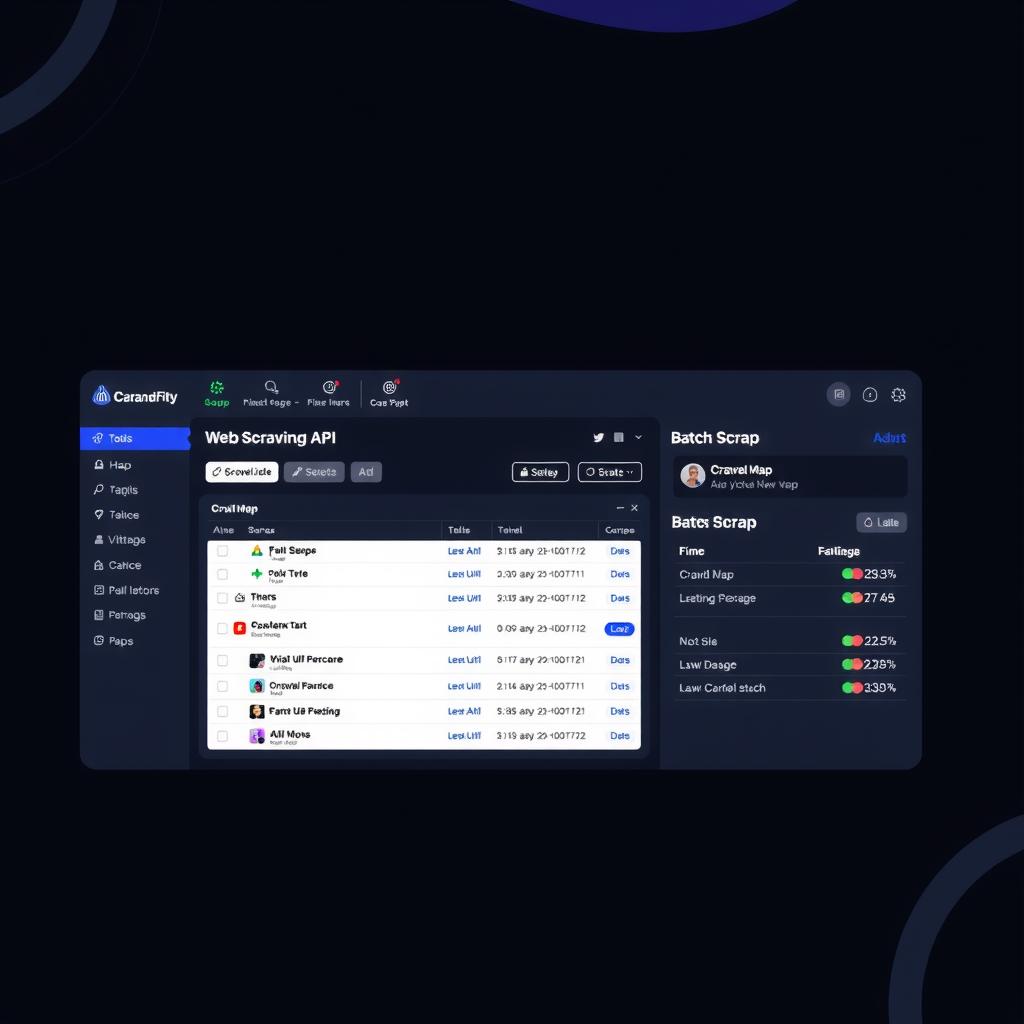
The crawl endpoint recursively scrapes an entire website up to a configurable page limit, with automatic URL discovery and politeness controls. Map discovers all URLs on a site instantly without crawling — useful for sitemap analysis and URL inventory. Both endpoints support filtering by URL pattern, domain, and search query. Batch scrape processes thousands of URLs asynchronously with automatic polling via SDKs.
Agent — Autonomous Data Gathering
The Agent endpoint is Firecrawl's highest-level abstraction: you describe what data you need in natural language and the agent autonomously searches, navigates, and extracts the information. It uses Spark models (Pro tier) for complex multi-step research tasks where the agent needs to explore multiple paths and synthesize findings from across the web.
MCP and Skill Integration
Firecrawl provides a native MCP server that connects any MCP-compatible client — Claude Code, Hermes Agent, OpenCode — to web scraping capabilities. The CLI skill system (`npx firecrawl-cli@latest init --all --browser`) installs Firecrawl as a tool for AI coding assistants in a single command. Integrations also exist for n8n, Zapier, Lovable, and custom workflows.
🔬 AI Performance Analysis
🦾 Ease of Use
Firecrawl is remarkably easy to integrate. The Python SDK wraps all endpoints with type hints and automatic polling for async operations. A single app.scrape("url") call returns clean Markdown. The MCP server connects to AI agents in under a minute. The playground at firecrawl.dev lets you test any endpoint without writing code. Self-hosting requires Docker Compose, which is the only friction point for non-technical users.
⚙️ Features
Firecrawl covers the full spectrum of web data needs: single-page scraping, site-wide crawling, URL discovery, web search with full content, interactive scraping, batch processing, and autonomous agent-driven research. The structured JSON extraction mode turns unstructured pages into structured data. Multi-format output (Markdown, HTML, screenshots, JSON) means one API serves LLM pipelines, data analysis, and visual documentation needs. The five official SDKs and MCP integration make it one of the most broadly connected web data APIs.
🚀 Performance
Firecrawl reports P95 latency of 3.4 seconds across millions of pages, which is competitive for a managed scraping service. The API handles JS rendering, proxy rotation, and anti-bot detection transparently — the real performance gain is eliminating the infrastructure you'd otherwise manage. Batch crawl operations scale well with async processing. The main bottleneck is credit consumption, not latency — complex interactive scraping sessions can consume significant credits for multi-step workflows.
📚 Documentation
Firecrawl's documentation is comprehensive and well-structured, covering every endpoint with code examples in Python, Node.js, cURL, and CLI. The API reference includes request/response schemas for all parameters. Quick-start guides get you scraping in under 5 minutes. The changelog and blog document feature releases with practical examples. The docs cover both cloud and self-hosted deployment paths, with the contributing guide providing clear self-hosting instructions.
🎯 Support
Firecrawl has an active community with 145K+ GitHub stars, a responsive Discord server, and maintainers who address issues within days. The GitHub issue tracker shows active engagement with bug reports and feature requests. The cloud version includes email support for paid plans. The open-source nature means community contributions supplement official support. The 388 open issues suggest active development but also that edge cases are still being discovered in production use.
🎯 Ideal Use Cases
✅ Best For
|
❌ Not Ideal For
|
Hobby plan includes 3,000 credits/month — enough for scraping ~3,000 pages or 1,500 search queries. Pro plans scale to 500,000+ credits. Self-hosted is free under AGPL-3.0 — you provide the infrastructure and API keys for upstream services.
Quick start: Sign up at firecrawl.dev → get API key → pip install firecrawl-py → app.scrape("any-url") in 3 lines.
| Overall Score | 8.4/10 |
| ❓ FAQ | |
|---|---|
| Is Firecrawl free to use? | Firecrawl offers a free Hobby plan with 3,000 credits per month, enough for light scraping and prototyping. The open-source version can be self-hosted for free under AGPL-3.0, though advanced features like Interact and Agent are cloud-only. Paid plans start at $16/month for 3,000 credits. |
| How does Firecrawl compare to Browser-Use? | Firecrawl is an API-first scraping service with managed infrastructure, while Browser-Use is a local browser automation framework. Firecrawl wins on reliability and ease of use — no proxy or browser management. Browser-Use offers more granular control over browser interactions and is free to self-host. |
| Can Firecrawl scrape JavaScript-heavy websites? | Yes. Firecrawl renders JavaScript and single-page applications automatically, handling SPAs, login walls, and dynamic content that traditional scrapers miss. The Interact mode goes further — you can click, scroll, and navigate before extracting content. |
| Does Firecrawl work with AI agents? | Firecrawl is designed for AI agent integration. It provides an MCP server for Claude Code and other MCP clients, CLI skills for agent workflows, and a Python/Node SDK for programmatic use. The Agent endpoint lets you describe what data you need in natural language and Firecrawl autonomously gathers it. |
| What formats does Firecrawl output? | Firecrawl outputs clean Markdown (optimized for LLM consumption), raw HTML, structured JSON via LLM extraction, screenshots (full-page or element-level), and metadata (title, description, language, OG tags). Markdown output is the primary format, designed to minimize token usage for AI pipelines. |
| 📖 Related Reads | |
|---|---|
| Browser-Use Review 2026 | Open-source browser automation for AI agents. Free and MIT-licensed, but requires more infrastructure than Firecrawl's managed API. |
| n8n Review 2026 | Workflow automation with Firecrawl integration. Connect web data extraction to business processes and AI pipelines. |
| Web Scraping with Python Guide (NiteAgent) | Step-by-step guide to building production web scrapers in Python, including Firecrawl integration patterns. |
| 📚 Verification & Citations | |
|---|---|
| https://github.com/firecrawl/firecrawl | Firecrawl GitHub Repository — source code, releases, contributor count, and issue tracker. Accessed July 2026. |
| https://docs.firecrawl.dev | Firecrawl Documentation — API reference, SDK guides, and self-hosting instructions. Accessed July 2026. |
| https://www.firecrawl.dev/blog/the-worlds-best-web-data-api-v25 | Firecrawl Blog — v2.5 benchmarks and reliability claims. Accessed July 2026. |
| https://firecrawl.dev | Firecrawl Official Website — pricing, features, and playground. Accessed July 2026. |
Firecrawl crossed 145,000 GitHub stars, cementing its position as the most-starred web scraping API on GitHub. The project has grown from 100K stars in early 2026, driven by MCP integration adoption and AI agent workflows [source].
Firecrawl shipped Interact mode, enabling users to click, scroll, and navigate pages before extracting content. The feature uses AI prompts to handle dynamic page interactions that static scraping cannot reach [source].
Firecrawl released its MCP server and CLI skill system, enabling direct web scraping from Claude Code, Hermes Agent, and other MCP-compatible AI assistants with a single install command [source].
Firecrawl launched the Agent endpoint, an autonomous data gathering feature that uses natural language prompts to search, navigate, and extract information from the web. Spark models (Pro tier) handle complex multi-step research tasks [source].
- July 5, 2026: Initial v4 canonical review published with full 14-section structure.
Is Firecrawl free to use?
Firecrawl offers a free Hobby plan with 3,000 credits per month, enough for light scraping and prototyping. The open-source version can be self-hosted for free under AGPL-3.0, though advanced features like Interact and Agent are cloud-only. Paid plans start at $16/month for 3,000 credits.
How does Firecrawl compare to Browser-Use?
Firecrawl is an API-first scraping service with managed infrastructure, while Browser-Use is a local browser automation framework. Firecrawl wins on reliability and ease of use — no proxy or browser management. Browser-Use offers more granular control over browser interactions and is free to self-host.
Can Firecrawl scrape JavaScript-heavy websites?
Yes. Firecrawl renders JavaScript and single-page applications automatically, handling SPAs, login walls, and dynamic content that traditional scrapers miss. The Interact mode goes further — you can click, scroll, and navigate before extracting content.
Does Firecrawl work with AI agents?
Firecrawl is designed for AI agent integration. It provides an MCP server for Claude Code and other MCP clients, CLI skills for agent workflows, and a Python/Node SDK for programmatic use. The Agent endpoint lets you describe what data you need in natural language and Firecrawl autonomously gathers it.
What formats does Firecrawl output?
Firecrawl outputs clean Markdown (optimized for LLM consumption), raw HTML, structured JSON via LLM extraction, screenshots (full-page or element-level), and metadata (title, description, language, OG tags). Markdown output is the primary format, designed to minimize token usage for AI pipelines.