📖 What Is Perplexity AI?
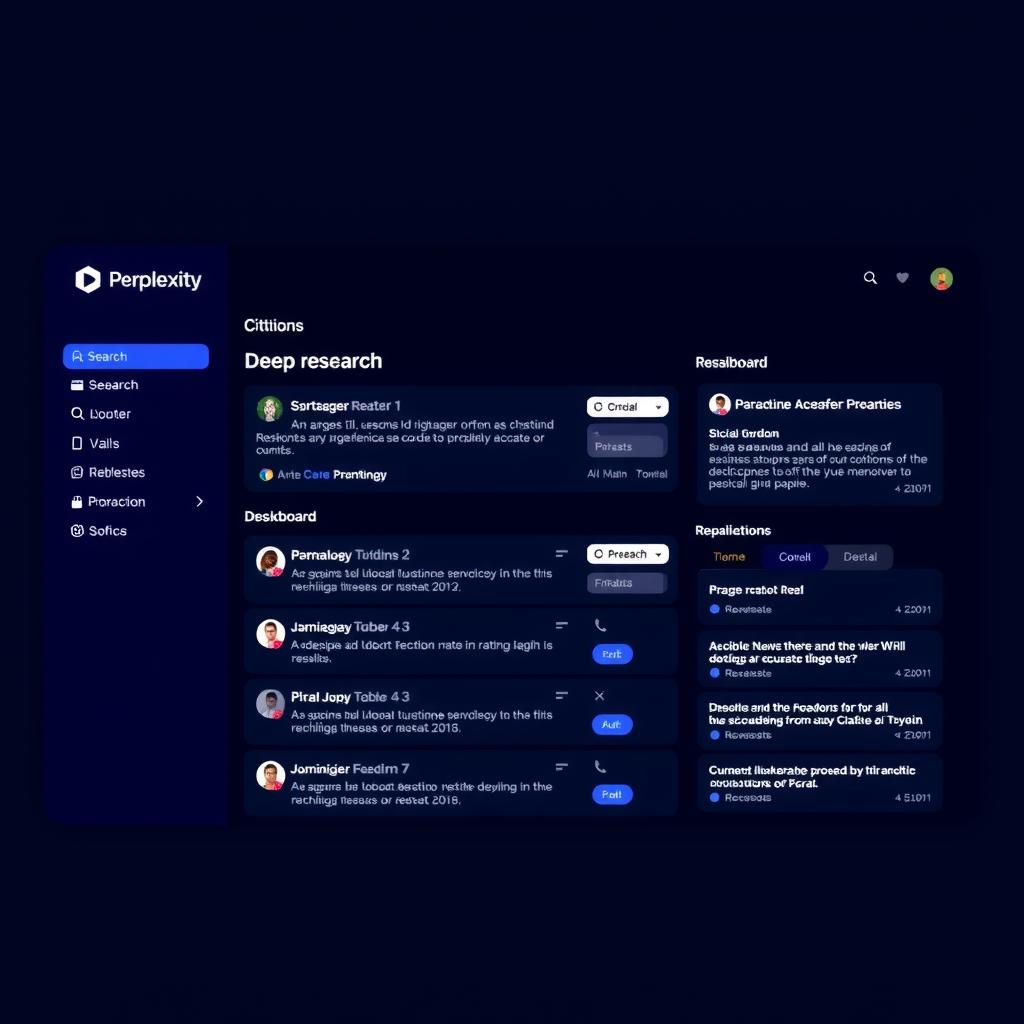
Perplexity is an AI-powered search engine that synthesizes answers from live web sources with numbered citations. Unlike ChatGPT or Claude where responses appear as black-box generations, every Perplexity answer includes clickable footnotes that take you directly to the source page. It launched to rapid adoption by positioning itself as a research-first tool rather than a general-purpose chatbot with search bolted on.
The platform runs on a proprietary search-and-synthesis stack that queries multiple indexes, reads the top results, and generates a paragraph-length answer with 4-8 citations in about 2-5 seconds. For deeper investigations, the Deep Research mode performs autonomous multi-step searches, reads hundreds of pages, and produces structured reports running 2,000-5,000 words. Perplexity is available on web, iOS, and Android, with a free tier and paid Pro subscription.
📊 At a Glance & ✅ Pros & Cons
| Feature | Perplexity AI | ChatGPT Search | Gemini |
|---|---|---|---|
| Category | AI Search | AI Search | AI Search |
| Pricing | $20/month | $20/month | $20/month |
| Free Tier | ✅ Limited | ✅ Limited | ✅ Yes |
| Deep Research | ✅ Autonomous | ✅ Basic | ✅ Advanced |
| Model Choice | ✅ 5 models | ❌ GPT only | ❌ Gemini only |
| Citations | ✅ Inline numbered | ✅ Partial | ✅ Partial |
| Mobile Apps | ✅ iOS + Android | ✅ iOS + Android | ✅ iOS + Android |
✅ What It Does Best
- Live citations on every answer. Every response includes numbered sources you can click to verify. No more guessing where the AI got its information.
- Deep Research mode is genuinely powerful. Runs dozens of searches, reads hundreds of sources, and produces comprehensive reports rivaling hours of manual research.
- Model choice matters. Pro users can switch between GPT-4, Claude, Gemini, Llama, and Perplexity's own Sonar models for the same query, picking the best tool for each task.
❌ Where It Falls Short
- Free tier is heavily limited. You get only a handful of Pro queries per day and limited file uploads. The $20/month Pro tier is practically required for regular use.
- Customer support is slow. Trustpilot reviews and Reddit complaints consistently cite multi-day to multi-week response times for support tickets.
- Deep Research can be slow. Comprehensive research reports take 2-5 minutes to generate, which feels glacial compared to standard search queries.
ChatGPT Search
OpenAI's web search integration — convenient if you already use ChatGPT, but lacks model choice and dedicated research depth.
GeminiGoogle's AI with Deep Research that ties directly into Google's index. Strong for fact-finding but less flexible for multi-source synthesis.
Open-source research assistant with local AI models and document search. Self-hostable but less polished than Perplexity's cloud offering.
✨ Capabilities & Agentic Deep Dive
Deep Research
Deep Research is Perplexity’s standout feature. Instead of a quick paragraph, it performs an autonomous multi-step investigation: it runs dozens of searches, reads hundreds of pages, reasons through contradictory information, and produces a structured report that can run 2,000-5,000 words. A single Deep Research query on “the state of AI agent memory systems in 2026” returned a report with six sections, thirty citations, and a comparison table — research that would take an afternoon to compile manually. The catch is speed: each run takes 2-5 minutes, and you can’t use Perplexity for other queries while it’s working.
Spaces, Collections, and Pages
Spaces are collaborative project folders where you can upload files, set custom instructions, and keep all your research in one place. You can create a Space for a specific project, upload PDFs and meeting notes, and ask questions that draw on both your private documents and the live web. For team use, Spaces support sharing and permissions. Collections are lighter-weight groupings for saving and organizing individual queries. Pages let you turn any Perplexity thread into a shareable, formatted article — useful for researchers sharing findings without copy-pasting screenshots.
Model Selection
One of Perplexity’s most underrated features is the ability to choose which LLM powers your search: GPT-4 for creative synthesis, Claude 4 Sonnet for nuanced reasoning, Gemini 3 Flash for speed, Llama 4 Maverick as an open-weight option, or Perplexity’s own Sonar optimized for search-grounded answers. This flexibility means you can match the model to the task — Sonar for quick factual queries, Claude for analysis, and Deep Research (which uses a combination) for heavy lifts. Being able to choose rather than being locked into one model is a genuine advantage over ChatGPT Search or Gemini’s built-in search.
🔬 AI Performance Analysis
🦾 Ease of Use
Perplexity's interface is minimal and intuitive: a search bar, a focus dropdown (All, Academic, Writing, Math, Video, Social), and a toggle for Deep Research. Answers appear within 2-5 seconds in standard mode. The learning curve is near zero — anyone who has used a search engine can pick it up immediately. The only friction is mode switching between standard search and Deep Research, which isn't always obvious to new users.
⚙️ Features
Deep Research is the headline feature, but Spaces, Collections, Pages, and model selection make it a full research platform. The focus modes (Academic, Writing, Math, Video, Social) tailor search results to the type of query. File uploads in Spaces support PDFs, images, and documents. What's missing: no code execution sandbox, no direct data analysis, and limited context windows for very long documents compared to Claude's 200K token window.
🚀 Performance
Standard search is fast — 2-5 seconds per query with 4-8 citations. Deep Research is the tradeoff: comprehensive reports in 2-5 minutes, which is slow by search standards but remarkably fast for the depth of research produced. The upgraded Deep Research announced in early 2026 now achieves state-of-the-art scores on leading research benchmarks, outperforming comparable tools from OpenAI and Google on several metrics. Response quality is consistently high across both modes.
📚 Documentation
Perplexity's documentation covers the API, Spaces setup, and feature guides adequately. The platform is straightforward enough that most users won't need extensive docs. API documentation is clear for developers integrating Perplexity search into their own applications. The knowledge base could be deeper on advanced use cases like custom Spaces configurations and Enterprise deployment, but the core product is well-documented enough for the average user.
🎯 Support
Customer support is Perplexity's weakest area. Trustpilot shows 1.5 stars out of 670+ reviews, almost entirely over support responsiveness. Users report waiting weeks for replies to billing issues. There's no phone support, no live chat for non-Enterprise users, and email responses are slow. Enterprise Max ($325/user/mo) includes priority support, but the price tag puts it out of reach for most teams. For a tool positioning itself as pro research platform, this is a significant gap.
🎯 Ideal Use Cases
✅ Best For
|
❌ Not Ideal For
|
Perplexity Pro is the sweet spot for anyone who does regular research. The free tier is useful for casual testing, but you'll hit the Pro query limit fast. Pro at $20/month unlocks unlimited Deep Research, model selection, and 500 uploads per day. Enterprise at $40/user/month is competitive for teams, while Enterprise Max at $325/user/month is for institutions needing unrestricted access and priority support.
Quick start: Create a free account at perplexity.ai, try the free tier for a few queries, and upgrade to Pro if you hit the limits within the first day — most power users do.
| ❓ FAQ | |
|---|---|
| Is Perplexity AI free? | Yes, there's a free tier with basic AI search and limited Pro queries per day. For unlimited searches, Deep Research, and model selection, you need Pro at $20/month. |
| How is Perplexity different from ChatGPT Search? | Perplexity is built specifically for research from the ground up. Every answer includes inline citations, you can choose which underlying model to use, and the Deep Research feature produces lengthy cited reports. ChatGPT Search is more of a bolt-on feature to a general chatbot. |
| Can Perplexity replace Google Search? | For research-heavy tasks, absolutely. For quick navigational queries or local business lookups, traditional search is still faster. Perplexity excels at questions that need synthesis across multiple sources. |
| Does Perplexity have a mobile app? | Yes, Perplexity has iOS and Android apps that include all features including voice search, camera-based queries, and Deep Research. |
| 📖 Related Reads | |
|---|---|
| ChatGPT Search Review | 8.0/10 | OpenAI's web search integration — convenient but less flexible than Perplexity |
| 💡 Multimodal Search & RAG in 2026 | Technical deep-dive on search architecture patterns powering tools like Perplexity |
| Gemini Review | 8.5/10 | Google's AI with Deep Research and direct Google index integration |
| 🧙 Build an AI Research Agent | Step-by-step guide on building your own research agent using Perplexity-style patterns |
| 📚 Verification & Citations | |
|---|---|
| Perplexity AI Homepage | https://www.perplexity.ai |
| Perplexity API Docs | https://docs.perplexity.ai |
| GitHub Repository | https://github.com/perplexityai |
| Trustpilot Reviews | Trustpilot — Perplexity AI |
- 2026-06-19 — Initial v4 canonical review published
📖 Related Reads
- ToolBrain — tool reviews, LLM comparisons, and AI workflow guides
- NoCode Insider — AI workflow automation with no-code tools, agents, and APIs
- CodeIntel Log — code quality, debugging, and software engineering benchmarks
- NiteAgent — AI agent development, frameworks, and production patterns
- Hermes Tutorials — Hermes Agent setup, configuration, and advanced workflows
Cross-links automatically generated from None.
Is Perplexity AI free?
Yes, there's a free tier with basic AI search and limited Pro queries per day. For unlimited searches, Deep Research, and model selection, you need Pro at $20/month.
How is Perplexity different from ChatGPT Search?
Perplexity is built specifically for research from the ground up. Every answer includes inline citations, you can choose which underlying model to use, and the Deep Research feature produces lengthy cited reports. ChatGPT Search is more of a bolt-on feature to a general chatbot.
Can Perplexity replace Google Search?
For research-heavy tasks, absolutely. For quick navigational queries ('openweathermap london') or local business lookups, traditional search is still faster. Perplexity excels at questions that need synthesis across multiple sources.
Does Perplexity have a mobile app?
Yes, Perplexity has iOS and Android apps that include all features including voice search, camera-based queries, and Deep Research.