RTK Review 2026: Rust Token Killer — CLI Proxy That Saves 60-90% on LLM Tokens
📖 What Is RTK?
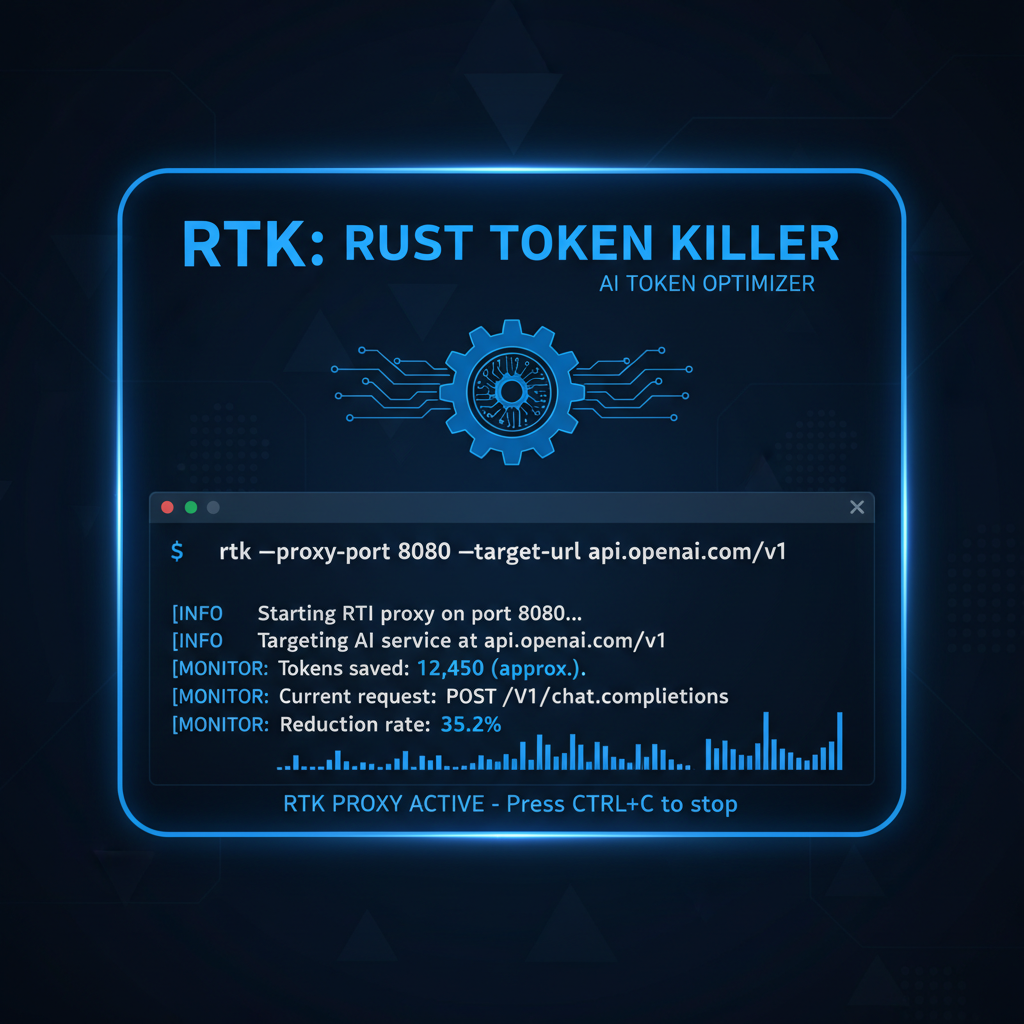
RTK (Rust Token Killer) is an open-source CLI proxy that sits between your AI coding agent and the shell, intercepting command outputs and compressing them before they reach the LLM context window. Built in Rust with zero dependencies, it reduces token consumption by 60-90% on common dev commands — making your AI sessions last longer, cost less, and reason better.
Install it with brew install rtk or a one-liner, run rtk init --global, and RTK automatically rewrites every Bash call to filter out CLI noise. After a few weeks of daily use, users report 15,720+ commands processed and 138M tokens saved with 88.9% average efficiency. It works transparently with Claude Code, Cursor, Aider, Gemini CLI, Codex, Windsurf, and GitHub Copilot.
📊 At a Glance & ✅ Pros & Cons
| Specification | RTK | Warp | DeepSeek-TUI |
|---|---|---|---|
| Category | CLI Token Proxy | AI-Powered Terminal | Terminal AI Interface |
| Pricing | Free (MIT) | Freemium ($10/mo Pro) | Free |
| License | MIT / Apache 2.0 | Proprietary | Apache 2.0 |
| Developer | rtk-ai | Warp Technologies | deepseek-ai / community |
| Launch Date | January 2026 | 2022 | 2025 |
| Stars | 56.5K+ | 22K+ | 15K+ |
| Key Differentiator | Transparent proxy that saves 60-90% tokens on CLI commands | Native terminal with AI command generation and smart autocomplete | TUI-native LLM interface with model switching and deep context |
✅ What It Does Best
- 80% avg. token reduction. Real 60-90% savings measured across 2,900+ commands; sessions last 3x longer.
- Zero-config install. Single brew install or one-liner; auto-works with Claude Code, Cursor, Aider, and more.
- 100+ commands supported. Git, test runners, linters, Docker, package managers, and filesystem tools.
- Open-source & fast. MIT licensed, single Rust binary, <10ms overhead, zero dependencies.
❌ Where It Falls Short
- Only CLI commands. Doesn't intercept LLM built-in tools (Read, Grep, Glob); only Bash calls through the shell hook.
- Young ecosystem. Cloud dashboard and team features still in waitlist; enterprise features coming.
- Limited to dev workflows. Primarily designed for coding agents; general LLM users need different solutions.
- Config needed for edge cases. Some commands may need manual exclusion rules in config.toml.
AI-powered terminal emulator with smart autocomplete, command generation, and native AI integration.
DeepSeek-TUIFree TUI-native LLM interface with model switching, deep context, and terminal-first design.
AiderFree open-source terminal pair programming. Benefits greatly from running alongside RTK.
Claude CodeAutonomous CLI coding agent with 1M context. RTK makes its sessions 3x more efficient.
✨ Capabilities & Agentic Deep Dive
Transparent CLI Proxy Architecture
RTK installs a global shell hook that rewrites every Bash call to an rtk equivalent at the proxy layer. The hook is set up with a single command (rtk init -g) and thereafter all CLI output is automatically filtered — no manual wrapping, no API changes, no configuration files needed for standard workflows. The hook works before your AI agent ever sees the output.
Four Compression Strategies
RTK uses four complementary strategies to reduce token count without losing signal. Smart filtering strips comments, whitespace, and boilerplate. Grouping aggregates similar items — files by directory, errors by type. Truncation keeps relevant context while cutting redundancy. Deduplication collapses repeated log lines with count summaries. Together, these strategies achieve 80%+ reduction on most commands while preserving test failures, errors, and diff content in full.
100+ Command Support
RTK supports major CLI commands across the development toolchain: filesystem (ls, find, tree, cat), git (status, diff, log, add), test runners (cargo test, pytest, go test), build/lint (tsc, eslint, ruff, clippy), package managers (npm, pnpm, pip, cargo), Docker/kubectl, and data tools (jq, yq). New commands are being added regularly by the 101-contributor open-source community.
RTK Ecosystem: Context Forge
RTK is part of a larger open-source ecosystem called Context Forge, built on a shared philosophy: Rust-native, zero telemetry, local-first. ICM (Infinite Context Memory) provides persistent memory across agent sessions so your coding agent picks up where it left off. Vox adds voice output for AI agents with 3 TTS backends and 4 Claude Code integration modes. RTK Cloud (team analytics, token dashboards, SSO) is in development with a waitlist open now.
🔬 AI Performance Analysis
🦾 Ease of Use
RTK is trivially easy to adopt. Install with Homebrew or a one-liner, run rtk init -g, and it works. No configuration file required for standard setups. The shell hook is transparent — you don't think about RTK after setup; it just runs. The rtk gain dashboard provides a satisfying real-time view of tokens saved. The only friction: users need to know which rtk init --agent flag matches their tool, and the built-in LLM tools (Read, Grep) aren't intercepted.
⚙️ Features
RTK's feature set is focused and practical. The auto-rewrite hook is the flagship feature — it makes token compression invisible to the user. 100+ command support covers the full dev toolchain. Multiple integration modes for every major coding agent. The rtk gain dashboard and configurable exclusion rules add polish. Missing pieces: the cloud dashboard, team analytics, and SSO are still in development. No GUI or web interface for local use. No plugin system for custom command handlers.
🚀 Performance
This is where RTK shines. Measured across 2,900+ real-world commands: cargo test 91.8% reduction, git status 80.8%, find 78.3%, grep 49.5%. In a 30-minute Claude Code session, tokens drop from ~118K to ~24K — an 80% reduction. The Rust binary adds less than 10ms overhead per command — imperceptible in practice. Zero dependencies means no runtime bloat. The only caveat: RTK's compression doesn't apply to built-in LLM tools (Read, Grep, Glob) that bypass the shell.
📚 Documentation
RTK's documentation is functional but lean. The GitHub README is thorough with installation guides, supported commands, and configuration examples. The website has clear copy and good demo data. However, there's no dedicated docs site, no API reference, no searchable knowledge base, and limited troubleshooting guides. Community documentation is growing organically through GitHub issues and Discord. For a tool this simple, the docs are adequate — but power users will want more depth on edge cases and custom configurations.
🎯 Support
RTK has strong community momentum with 56.5K GitHub stars, an active Discord server, and 101 contributors. The project is under active development with 1,060+ commits and regular releases (v0.42.0 as of May 24, 2026). Issues are handled through GitHub with reasonable response times. There's no formal support SLA or enterprise support tier yet — the cloud offering is expected to address this. For an open-source tool, the community support is solid, but paid users will want a dedicated channel.
🎯 Ideal Use Cases
✅ Best For
|
❌ Not Ideal For
|
RTK is completely free and open-source under the MIT license. No usage limits, no telemetry, no accounts. Install in 30 seconds and start saving tokens immediately. RTK Cloud (team analytics, token dashboards, SSO, audit logs) is in the works with a free tier for open-source projects and paid plans from $15/dev/month.
Quick start: Run curl -fsSL https://raw.githubusercontent.com/rtk-ai/rtk/refs/heads/master/install.sh | sh or brew install rtk. Then rtk init --global to activate the hook for all terminal AI tools. Run rtk gain to see your token savings in real time.
| Dimension | Score |
|---|---|
| Overall Score | 8.0/10 |
| ❓ FAQ | |
|---|---|
| Does RTK work with every AI coding tool? | Yes — RTK supports Claude Code, Cursor, Aider, Gemini CLI, OpenAI Codex, Cline, Windsurf, and GitHub Copilot. Run rtk init --agent [tool] to set up the integration for any supported agent. |
| Does RTK affect code quality or miss important output? | No. RTK only removes boilerplate — test failures, error messages, and diff content are preserved in full. It strips comments, whitespace, and redundant status lines that waste context window space. |
| Is RTK free to use? | Yes, RTK is MIT licensed with no usage limits, no telemetry, and no account required. RTK Cloud (team analytics, token dashboards, SSO) is on the roadmap with a free tier for open-source projects. |
| How much can RTK actually save? | Measured across 2,900+ real-world commands: cargo test saves 91.8%, git status saves 80.8%, find saves 78.3%. A typical 30-minute Claude Code session drops from ~118K tokens to ~24K — an 80% reduction. |
| Does RTK collect my data or code? | No. Telemetry is disabled by default and requires explicit opt-in consent. RTK never collects source code, file paths, command arguments, secrets, environment variables, or personal data of any kind. |
| 📖 Related Reads | |
|---|---|
| Warp Review 2026 | 7.7/10 | AI-powered terminal emulator with smart autocomplete, command generation, and native AI integration for modern developers. |
| DeepSeek-TUI Review 2026 | 6.8/10 | Free TUI-native LLM interface with multi-model support, deep context windows, and terminal-first design philosophy. |
| Aider Review 2026 | 7.8/10 | Free open-source terminal pair programming. Works great alongside RTK to stretch API token budgets further. |
| Claude Code Review 2026 | 8.2/10 | Anthropic's autonomous coding agent with 1M context and Agent Teams. RTK integration makes sessions 3x more efficient. |
| 📚 Verification & Citations | |
|---|---|
| RTK Official Website | RTK homepage with product overview, demo, pricing, and ecosystem info. Accessed May 2026. |
| RTK GitHub Repository | 56.5K stars, 1,060+ commits, 101 contributors. MIT/Apache 2.0 licensed. Accessed May 2026. |
| RTK Token Savings Data | Empirical savings data across 2,900+ commands: cargo test 91.8%, git status 80.8%, find 78.3%. Accessed May 2026. |
| RTK Releases | v0.42.0 released May 24, 2026. Active release cadence with 191 tags. Accessed May 2026. |
| RTK Cloud Waitlist | Team analytics, token dashboards, SSO. Free for open-source. From $15/dev/month. Accessed May 2026. |
| RTK Discord Community | Community support and discussion channel. Accessed May 2026. |
Latest release adds support for 10 new commands including kubectl, docker compose, and pnpm. Improved grouping algorithms for test output and better error-preservation in truncation mode. 191 tags and counting on a rapid release cadence.
Community momentum continues with 101 contributors and 1,060+ commits. Growing adoption across developer toolchains with integrations for Claude Code, Cursor, Aider, Gemini CLI, Codex, Cline, Windsurf, and GitHub Copilot.
- May 30, 2026: Initial review published. Covering RTK (Rust Token Killer) as an open-source CLI proxy for token reduction in AI coding workflows.
Does RTK work with every AI coding tool?
Yes — RTK supports Claude Code, Cursor, Aider, Gemini CLI, OpenAI Codex, Cline, Windsurf, and GitHub Copilot. Run `rtk init --agent [tool]` to set up the integration for any supported agent.
Does RTK affect code quality or miss important output?
No. RTK only removes boilerplate — test failures, error messages, and diff content are preserved in full. It strips comments, whitespace, and redundant status lines that waste context window space.
Is RTK free to use?
Yes, RTK is MIT licensed with no usage limits, no telemetry, and no account required. RTK Cloud (team analytics, token dashboards, SSO) is on the roadmap with a free tier for open-source projects.
How much can RTK actually save?
Measured across 2,900+ real-world commands: cargo test saves 91.8%, git status saves 80.8%, find saves 78.3%. A typical 30-minute Claude Code session drops from ~118K tokens to ~24K — an 80% reduction.
Does RTK collect my data or code?
No. Telemetry is disabled by default and requires explicit opt-in consent. RTK never collects source code, file paths, command arguments, secrets, environment variables, or personal data of any kind.