OpenClaw is an open-source AI agent that connects to your messaging apps and lets you talk to LLMs through Telegram, Discord, Signal, Slack, and 20+ other channels — all running on your own infrastructure.
If you are weighing OpenClaw against the alternatives, our comparison database keeps a live scorecard of how the leading AI Agent tools stack up.
TL;DR: It's a self-hosted, multi-channel AI gateway. Think "ChatGPT, but I control where it runs, what models it uses, and what tools it has access to."
How It Works
You (in Telegram) → OpenClaw → LLM Provider → OpenClaw → Response back to you
    ↓
    Plugins, search, memory, tools
Everything runs on your hardware. No data leaves your VPS unless you choose to use a cloud LLM provider. You can run entirely local models via Ollama or LM Studio.
Who Is It For?
| You might want OpenClaw if... | ...and probably not if |
|---|---|
| You want AI that runs on your own hardware | You're happy with ChatGPT web/app |
| You need multi-channel support (Telegram + Discord + Slack) | You just need one bot on one platform |
| You care about data privacy and self-hosting | You don't want to manage a server |
| You want to customize and extend the agent | You want a plug-and-play SaaS product |
| You're a developer or tech-literate power user | You want no-config, zero-setup |
What Does "Open Source" Mean Here?
OpenClaw is MIT-licensed. You can:
- Run it anywhere — VPS, Raspberry Pi, your laptop
- Modify the code — add features, remove what you don't need
- Inspect everything — no black boxes, no telemetry you can't disable
- Deploy for commercial use — no licensing fees, no per-seat costs
The entire codebase is on [GitHub](https://github.com/openclaw/openclaw).
Getting Started with OpenClaw
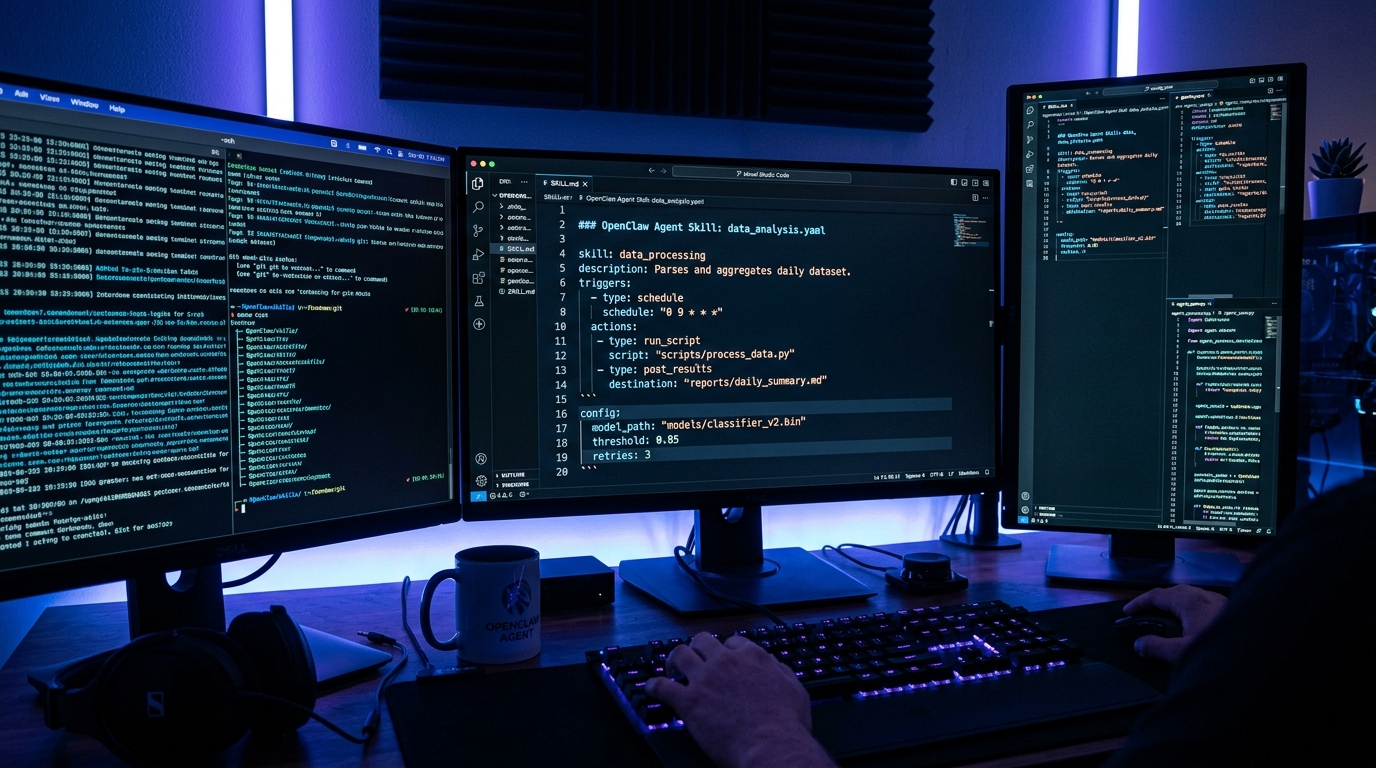
Setting up OpenClaw takes about 15 minutes if you are comfortable with the command line. The process: clone the repository from GitHub, install the Python package with pip install openclaw, configure your LLM provider in a YAML file, and connect a messaging channel like Telegram or Discord. OpenClaw supports any OpenAI-compatible API, so you can use DeepSeek, Google Gemini, Anthropic Claude, or run entirely local models through Ollama. The official GitHub repository has extensive documentation and community-contributed guides for every major deployment scenario.
Once running, you interact with OpenClaw through your messaging app like any other contact. Send it a task — "research the latest developments in vector databases and save a summary" — and it plans the steps, executes them using its available tools, and delivers the result back to your chat. No web dashboard, no separate app to check. Just your messaging app.
Security and Cost Considerations
Self-hosting an agent shifts responsibility to you. Because OpenClaw runs on your own server, you control the firewall, the encryption, and who can reach the service — but you also own patching and backups. The official documentation recommends running it behind a reverse proxy with TLS, restricting access to approved messaging channels, and using API keys scoped to individual models rather than shared credentials. It also warns against granting the agent access to sensitive local services unless you have explicitly reviewed the plugin code doing the integration, since plugins run with the same permissions as the agent process.
On cost, the economics are favorable for heavy users. Self-hosted OpenClaw has no license fee, and if you point it at an OpenAI-compatible API you pay only per token consumed. Running local models via Ollama eliminates API costs entirely, at the price of needing a machine with a capable GPU. For teams, the total cost of a small VPS plus API usage is typically a fraction of per-seat SaaS agent subscriptions, especially once you are running scheduled automations that would otherwise idle on a paid plan.
Why Open Source Matters for AI Agents
The open-source nature of OpenClaw provides transparency that proprietary AI services cannot match. Every line of code is visible on GitHub, meaning security researchers, developers, and auditors can verify exactly what the agent does. There are no hidden telemetry calls, no unexpected data sharing, and no vendor lock-in. If you decide to switch to a different agent framework tomorrow, you take your configuration, memory, and tool integrations with you — no data migration, no export process.
This transparency has driven rapid community growth. The OpenClaw ecosystem now includes hundreds of community-built plugins covering web scraping, database connections, API orchestration, and custom tool integrations. The plugin system uses a simple Python interface — any developer can create a new plugin with about 50 lines of code and publish it to the community registry. This extensibility means OpenClaw adapts to your specific needs rather than forcing you to adapt to its limitations.
Real-World Use Cases
OpenClaw's versatility makes it suitable for a wide range of applications beyond simple Q&A. Developers use it for automated code reviews that run on a schedule — the agent checks for new pull requests, reviews code quality, and posts feedback directly to a Discord channel. Content creators set up research pipelines where OpenClaw monitors specific topics, collects information from multiple sources, and drafts summaries for review. Privacy-conscious users appreciate that every message is processed on their own hardware, with no data sent to third-party servers beyond the explicitly authorized model API calls.
The sub-agent system is particularly powerful for complex tasks. Instead of handling everything in one long chain, OpenClaw can spawn parallel sub-agents — one searches the web while another reads files and a third drafts output — then merge results together. This parallel execution makes multi-step workflows dramatically faster than sequential processing.
Dig deeper: OpenClaw review · IronClaw review.
Back to all posts