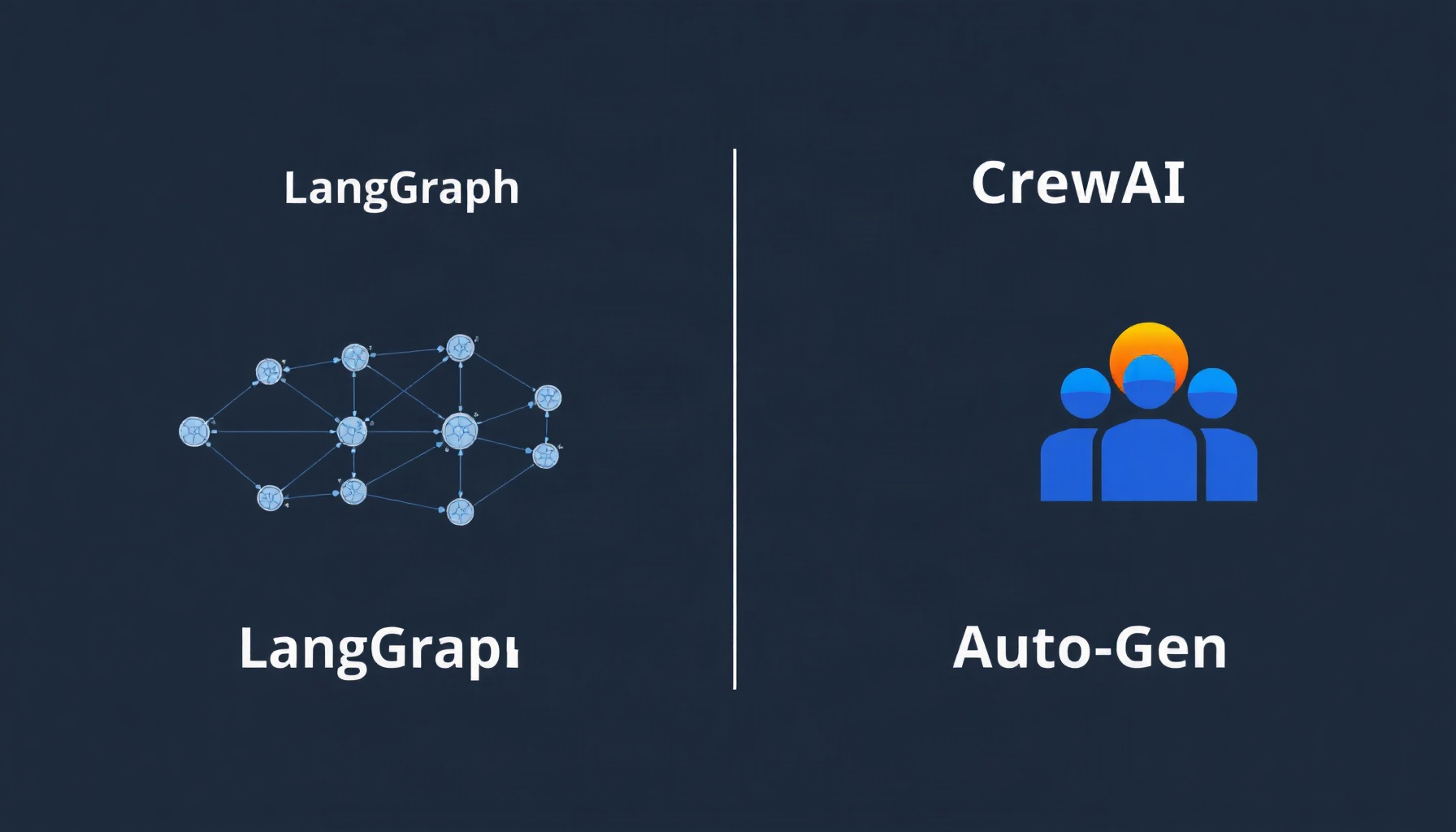
AI Agent Frameworks 2026: LangGraph vs CrewAI vs AutoGen Compared for Beginners
Start with CrewAI. Its role-based approach is the most intuitive way for a beginner to build a working multi-agent setup, and its free tier is genuinely usable. Choose LangGraph instead if you want maximum control and are willing to climb a steeper learning curve — and skip AutoGen entirely, because Microsoft has placed it in maintenance mode and now points newcomers elsewhere.
How We Tested
This comparison is based on official documentation, pricing pages, and published third-party reports as of August 2026 — we did not run the tools hands-on. Every feature claim, price, license, and maintenance status below comes from primary sources, including LangGraph’s GitHub repository, CrewAI’s pricing page, and AutoGen’s official README. We verified what each project documents about itself: features, free and paid tiers, license terms, and project status. We did not verify real-world build experience or actual agent output quality in production, so treat the scores as a structured summary of documented capability and ecosystem health — not lab benchmarks.
The Scorecard
| Category | LangGraph | CrewAI | AutoGen |
|---|---|---|---|
| Overall Score | 7.8/10 | 7.8/10 | 6.0/10 |
| Ease of Use | 6/10 | 8/10 | 5/10 |
| Features | 9/10 | 8/10 | 7/10 |
| Performance | 7/10 | 8/10 | 7/10 |
| Documentation | 9/10 | 8/10 | 7/10 |
| Support | 8/10 | 7/10 | 4/10 |
LangGraph and CrewAI finish tied at the top for different reasons: LangGraph leads on raw features and documentation, while CrewAI wins clearly on ease of use. AutoGen’s numbers reflect a project in transition — the documentation is still online and the feature set is intact, but maintenance mode on the official README means no new features and community-managed upkeep, which lands hardest on the Support score. Neither leader is perfect, though; the right pick depends on how much control you need versus how fast you want your first agent running.
What Each Tool Is
LangGraph
LangGraph is a low-level orchestration framework from the LangChain team for building long-running, stateful AI agents. You design agents as nodes and edges in a graph — a model inspired by Google’s Pregel and NetworkX — and the framework layers on durable execution (agents survive failures and resume), human-in-the-loop approval steps, comprehensive memory, and debugging through LangSmith, all documented in the official LangGraph overview. It’s MIT-licensed, runs on Python and JavaScript/TypeScript, and ships a visual debugger called LangGraph Studio plus a free LangChain Academy course, per the project’s GitHub — and it’s used in production by Klarna, Replit, and Elastic. We cover the trade-offs in our full LangGraph review.
CrewAI
CrewAI is an open-source Python framework for multi-agent collaboration, and its core idea is easy to grasp: you assign roles. A “researcher” agent gathers information, a “writer” agent drafts the result, and CrewAI coordinates the handoffs between them. It supports two modes — Crews (role-based agents that work together) and Flows (event-driven, deterministic pipelines) — alongside 60+ built-in tools, and CrewAI reports 100,000+ developers certified through its community courses. For the full picture, read our full CrewAI review or browse the project’s source.
AutoGen
AutoGen is Microsoft’s open-source multi-agent framework: MIT-licensed, Python-based, with a no-code GUI called AutoGen Studio, multi-agent orchestration, and support for MCP (Model Context Protocol) tools, as described in the official AutoGen docs. Here’s the honest part: as of August 2026, the official GitHub README confirms AutoGen is in maintenance mode — it will not receive new features and is managed by the community going forward. Microsoft directs new users to its successor, Microsoft Agent Framework (MAF), which is production-ready at v1.0, MIT-licensed, supports Python and C#/.NET, works with multiple model providers, and interoperates via A2A and MCP. If that sounds interesting, our Microsoft Agent Framework v1.0 review is a better starting point than AutoGen itself.
Pricing Compared
| Tool | Free | Paid | Key Limits |
|---|---|---|---|
| LangGraph | Open-source (MIT); LangChain platform Developer tier at $0/seat/month | Plus at $39/seat/month; Enterprise custom | Developer includes up to 5k base traces/mo; Plus raises it to 10k traces and adds access to Deployment and Engine |
| CrewAI | Open-source (MIT); AMP Basic tier free | AMP Enterprise, custom-priced | AMP Basic includes the visual editor, GitHub integration, and 50 workflow executions/month; Enterprise adds SSO, RBAC, and deployment on your own VPC or CrewAI cloud |
| AutoGen | Free (MIT) | None | Project is in maintenance mode |
Figures come from LangChain’s official pricing page plus CrewAI’s AMP page and its pricing page. Note that all three frameworks cost nothing at the open-source level — what you eventually pay for is the platform around them: hosted tracing, deployment, visual editors, and support. One caution: AutoGen being free is not a reason to adopt it. Microsoft publishes a migration guide for moving AutoGen projects to the new framework, which tells you exactly where the company’s attention is.
Pros and Cons
LangGraph
Pros
- Production-grade features: durable execution, human-in-the-loop approvals, comprehensive memory
- Supports both Python and JavaScript/TypeScript
- Free LangChain Academy course and the LangGraph Studio visual debugger
- Proven in production at Klarna, Replit, and Elastic
Cons
- Steep learning curve — state graphs take time to learn and aren’t beginner-friendly
- Python-first core
- Abstraction overhead makes simple linear workflows feel heavier than they should
- Platform pricing adds up once you exceed free trace limits
Bottom line: the most capable of the three — if you’re willing to pay for that power in learning time.
CrewAI
Pros
- Role-based Crews map naturally to how beginners already think about agents
- Two modes cover flexible collaboration (Crews) and deterministic pipelines (Flows)
- 60+ built-in tools, plus a free AMP Basic tier with a visual editor
- Large certified community — 100,000+ developers
Cons
- Python only; no JavaScript or TypeScript support
- Event-driven Flows have their own learning curve
- Observability and tracing are only in the paid AMP suite
- Enterprise pricing is hidden behind a sales conversation
Bottom line: the easiest path from zero to a working multi-agent project.
AutoGen
Pros
- Completely free under an MIT license
- AutoGen Studio offers a no-code GUI
- Handles multi-agent orchestration and MCP tools
Cons
- In maintenance mode: no new features, community-managed upkeep
- Microsoft officially steers new users to MAF instead
- Community energy is shifting to the successor, which weakens long-term support
Bottom line: a finished chapter, not a starting point.
Beginner Takeaway
If you’re new to AI agents, start with CrewAI, because its role-based model (“a researcher and a writer working together”) is the easiest to understand, the free AMP Basic tier lets you build visually without paying, and you won’t outgrow it — Flows are ready when your projects need deterministic pipelines. Move up to LangGraph as your second framework once you want fine-grained control over state, memory, and long-running agents; the free LangChain Academy course softens its learning curve. Whatever you do, don’t start with AutoGen in 2026 — beginning a new project on a framework Microsoft itself has moved past is a poor bet, and if you’re in the Microsoft ecosystem, evaluate MAF instead. You can see how all three stack up against other options in our AI Agent comparison hub.
Who Should (and Shouldn’t) Use Each
CrewAI
Choose it if you’re a beginner, a solo builder, or a small team that wants working multi-agent systems quickly and prefers thinking in roles over graphs. Skip it if your stack is JavaScript-first or you need built-in tracing without a paid plan — Python-only support and paywalled observability are its two hardest limits.
LangGraph
Choose it if you’re building long-running, stateful agents where reliability matters — durable execution and human-in-the-loop approvals are exactly what serious production deployments need. Skip it if you’re a complete beginner who wants results this week; the graph model will slow you down before it speeds you up.
AutoGen
Almost nobody should start with AutoGen in 2026. Choose it only if you’re maintaining an existing AutoGen codebase, and plan an exit: the official migration guide covers the path to MAF. Everyone else should pick CrewAI or LangGraph.
Where We’re Headed Next
This comparison is part of our AI Agent category expansion — we’re at 22/25 tools compared and adding more weekly. Track progress at /roadmap/. See what’s next in our review pipeline at /cron-pipeline/.
📖 Related Reads
- NiteAgent — AI agent development, frameworks, and production patterns
- NoCode Insider — AI workflow automation with no-code tools, agents, and APIs
- CodeIntel Log — code quality, debugging, and software engineering benchmarks
- Hermes Tutorials — Hermes Agent setup, configuration, and advanced workflows
Cross-links automatically generated from None.
Back to all posts